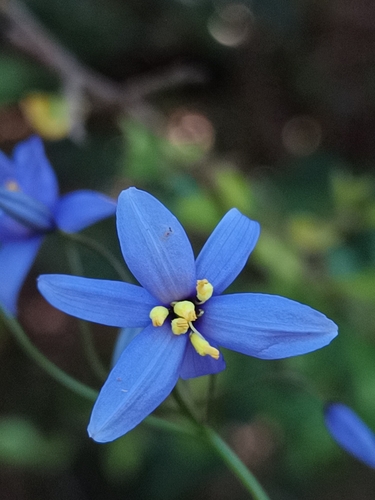
Stypandra, Genus, glauca, Species,
- Genus & species
nodding blue lily
Overview
Stypandra glauca is a tufted evergreen perennial herb growing 0.3-1 m (12-39 in) tall and 0.3-0.6 m (12-24 in) wide, native to southern and eastern Australia. It spreads slowly from a short rhizome to form clumps of arching, strap-like leaves that are blue-green and waxy, the source of the species name glauca. In spring, wiry branched stems rise above the foliage and carry many nodding star-shaped flowers about 2 cm (0.8 in) across, blue with a tuft of bright yellow, hairy stamens at the centre. The flowers open in succession over several weeks and are followed by small capsules. It grows in dry forest, woodland, heath, and rocky outcrops on sandy or gravelly well-drained soils, often among rocks, and tolerates frost and dry spells once established. All parts are toxic to grazing animals, and the plant has caused blindness and death in goats and sheep that eat it. The foliage can look tired by late summer, when older leaves brown off before fresh growth returns.
Native Range
Native to southern and eastern Australia, occurring in Western Australia, South Australia, Victoria, New South Wales, Queensland, and Tasmania, where it grows in dry sclerophyll forest, woodland, heath, and on rocky outcrops on light, well-drained soils.Suggested Uses
Used in native, rockery, and dry-shade gardens, on slopes, and in containers, and for habitat and revegetation plantings. The blue spring flowers suit lightly shaded native borders. Spaced 30-50 cm (12-20 in) apart in groups.How to Identify
Appearance
Size & Dimensions
Height1' - 3'3"
Width/Spread1' - 2'
Bloom Information
Nodding blue flowers open through spring, roughly September to November, a few at a time over several weeks on branched stems held above the leaves. Each flower lasts a day or two, opening in sequence. Small capsules follow in early summer.
Detailed Descriptions
Flower Description
blue with yellow stamensFoliage Description
blue-greenGrowing Conditions
Sun Requirements
Requires 4-7 hours of direct sunlight daily
• Full Sun: 6+ hours of direct sunlight
• Partial Shade: 3-6 hours of direct sunlight
• Full Shade: Less than 3 hours of direct sunlight
Care & Maintenance
Care Guide
Grow in part shade to full sun on light, sharply drained sandy or rocky soil of low fertility, including among rocks and on slopes. Water to establish, then rely largely on rainfall, as the plant tolerates dry periods and rots in wet ground. Cut back tired or browned foliage in late summer to make way for fresh leaves. It needs little feeding and withstands frost. All parts are toxic if eaten, which is relevant where stock or grazing pets have access. Divide congested clumps in autumn to keep them vigorous.Pruning
Shear off spent flowering stems after bloom and remove browned older leaves in late summer to tidy the clump. Fresh foliage follows with autumn and winter rains. No woody pruning is needed.Pruning Schedule
Prune: February–March
summer
Container Growing
Suitable for container growing
Minimum container size: 3 gallons