Overview
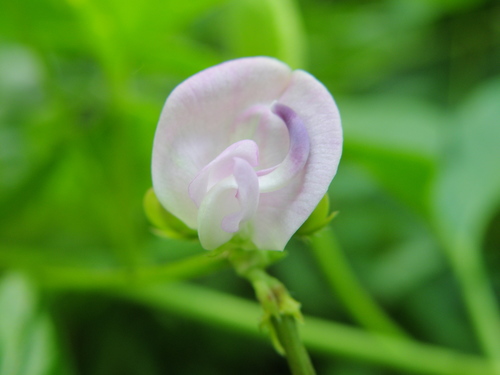
Strophostyles helvola is a trailing and twining annual legume native to eastern and central North America, with slender stems sprawling 3-8 ft (0.9-2.4 m) over the ground and low vegetation. The leaves are divided into three leaflets, each 1-2.5 in (2.5-6 cm) long and often marked by a rounded basal lobe that gives them a mitten-like outline. From summer into fall it bears clusters of pink to pinkish-purple pea-shaped flowers about 0.5 in (12 mm) long, with a slender keel that curves upward. Slender, hairy pods 1.5-3.5 in (4-9 cm) long follow, splitting to release seeds covered in soft woolly hairs, the source of the name fuzzy-bean. It grows on sandy soils, dunes, riverbanks, open woods, and disturbed ground. As an annual it dies each year and depends on reseeding to return. The sprawling stems can scramble over and shade small neighboring plants. It fixes nitrogen, and the seeds feed birds and small mammals.
Native Range
Native to eastern and central North America, from Quebec and Ontario south to Florida and Texas. It grows on sandy beaches, dunes, riverbanks, lake shores, open woodlands, and disturbed sandy ground.Suggested Uses
Used in dune stabilization, sandy native plantings, and pollinator plantings on open ground. It is sown in drifts on bare sandy sites where its trailing stems knit loose soil. The flowers draw native bees and the seeds feed birds and small mammals.How to Identify
Appearance
Size & Dimensions
Height6" - 1'
Width/Spread3' - 8'
Bloom Information
Detailed Descriptions
Foliage Description
greenGrowing Conditions
Sun Requirements
Requires 6-12 hours of direct sunlight daily
• Full Sun: 6+ hours of direct sunlight
• Partial Shade: 3-6 hours of direct sunlight
• Full Shade: Less than 3 hours of direct sunlight
Water & Climate
Water Needs
Drought Tolerance
Drought tolerant when established
Care & Maintenance
Care Guide
Strophostyles helvola grows in full sun on dry, sandy, well-drained soils and tolerates drought, heat, and low fertility at a pH of 5.5-7.5. As a nitrogen-fixing legume it grows on poor sandy ground without added fertilizer. It is grown from seed sown directly in spring after frost, germinating as the soil warms. Being an annual, it completes its cycle in one season and returns only from self-sown seed. It does not tolerate dense shade or wet, heavy soils. Few pests or diseases affect it.Pruning
No pruning is needed for this annual vine. Stems may be trimmed back to keep them from smothering smaller plants. Leaving spent pods in place allows seed to drop for the next year.Toxicity
Non-toxicPlanting Guide
Planting Methods & Timing
Planting Method
direct sow
Direct Sow Timing
Spring, after the last frost once the soil has warmed
Days to Maturity
90–120 days
Plant Spacing
18 inches
Companion Planting
Good Companions