Overview
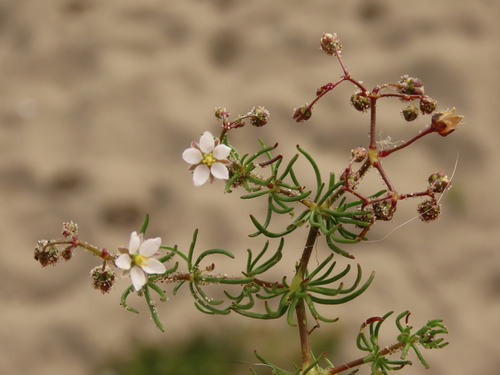
Spergula arvensis is a slender annual of arable fields and disturbed ground, growing 4-16 inches (10-40 cm) tall on weak, often sprawling, branched stems. Its narrow, fleshy, linear leaves are 0.4-1.2 inches (1-3 cm) long and grow in dense whorl-like clusters at each node, giving the stem a tiered, almost bristly look. From early summer into autumn it carries loose branched heads of small white five-petaled flowers about 0.2 inch (4-5 mm) across, opening a few at a time and closing in dull weather. Each flower produces a small capsule packed with tiny rounded blackish seeds, and a single plant can set thousands of seeds that persist for years in the soil. It germinates in spring or autumn and completes its life within a season. It grows on light, sandy, acidic soils low in lime, often as a weed of cereal and root crops, and was once sown as a fodder and green-manure crop. Dense stands compete with arable seedlings, a drawback in cultivated ground. Its sticky-glandular stems can feel tacky to the touch in some forms.
Native Range
Spergula arvensis is native to Europe and western Asia but now grows almost worldwide as a weed of cultivation. It occupies light, sandy, acidic arable soils, gardens, tracksides, and other disturbed open ground.Suggested Uses
Seldom grown by choice, it has historically been sown as fodder and green manure on poor sandy land. It can be included in arable-weed conservation plots that support farmland birds and insects. Its seeds are eaten by finches and other seed-feeding birds.How to Identify
Appearance
Size & Dimensions
Height4" - 1'4"
Width/Spread4" - 1'
Bloom Information
Flowering runs from June to September, with small white flowers in loose branched heads. They are pollinated by small insects or self-pollinate. Capsules of tiny black seeds ripen and shed through summer and autumn, and the seed survives many years in the soil.
Detailed Descriptions
Foliage Description
Mid greenGrowing Conditions
Sun Requirements
Requires 6-10 hours of direct sunlight daily
• Full Sun: 6+ hours of direct sunlight
• Partial Shade: 3-6 hours of direct sunlight
• Full Shade: Less than 3 hours of direct sunlight
Water & Climate
Water Needs
Drought Tolerance
Drought tolerant when established