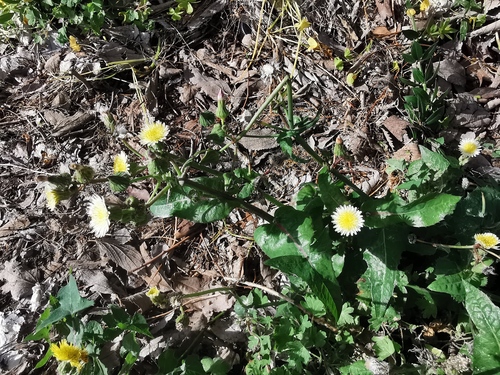
Sonchus, Genus, oleraceus, Species,
- Genus & species
annual sow thistle
Europe, western Asia, and northern Africa
SunFull Sun – Part Shade
WaterMedium
Overview
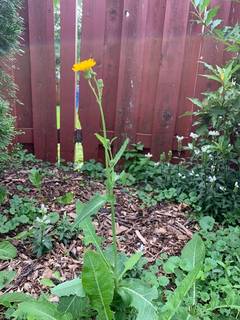
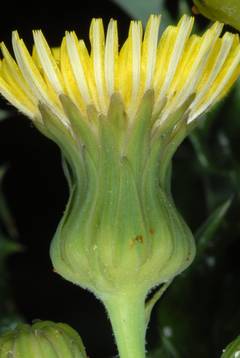
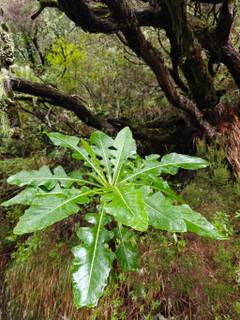
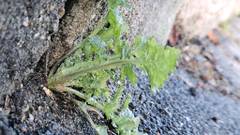
Sonchus oleraceus is an erect taprooted annual in the family Asteraceae reaching 12-48 inches (30-120 cm) tall and 6-18 inches (15-45 cm) wide. Stems are erect, hollow, branching in the upper half, carrying milky latex throughout. Leaves are alternate, deeply pinnately lobed with a large triangular terminal lobe, 2-10 inches (5-25 cm) long, medium to blue-green. Marginal spines are soft and flexible, versus the stiff and prickly spines of S. asper. Leaf bases clasp the stem with pointed arrow-shaped (sagittate) auricles, which is a key separation from S. asper and its rounded auricles. Leaf surfaces are flat (not curled or crinkled like S. asper). Flower heads are yellow, 0.6-1 inch (15-25 mm) in diameter, composed entirely of ligulate florets, in loose terminal clusters. Fruit is a flattened achene with smooth faces (no ribs, versus 3 ribs per face in S. asper), topped with a white pappus. A single plant produces 5,000-25,000 seeds. The species is widely distributed in gardens, nurseries, and cultivated fields worldwide and is present on every continent except Antarctica.
Native Range
Sonchus oleraceus is native to Europe, western Asia, and northern Africa, in gardens, cultivated fields, nurseries, roadsides, and disturbed ground from sea level to approximately 8,000 feet (2,400 m). Naturalized across all 50 U.S. states and all Canadian provinces and distributed on every continent except Antarctica.Suggested Uses
Used in the three-species Sonchus identification exercise: S. oleraceus (soft spines, deeply lobed, pointed auricles, smooth achenes) versus S. asper (stiff spines, curled leaves, rounded auricles, ribbed achenes) versus S. arvensis (perennial rhizomatous, large heads, glandular peduncles). The pointed-versus-rounded auricle comparison between S. oleraceus and S. asper is a key vegetative exercise. Edible as a cooked green with a long history of European and Asian use. The milky latex places Sonchus in the chicory tribe alongside Lactuca, Taraxacum, and Cichorium.How to Identify
Appearance
Size & Dimensions
Height1' - 4'
Width/Spread6" - 1'6"
Bloom Information
Yellow ligulate flower heads 0.6-1 inch (15-25 mm) in diameter in loose terminal clusters, borne April through October continuously over 12-16 weeks. Self-pollinating and insect-pollinated. Seeds mature 2-3 weeks after flowering and disperse by wind. Multiple generations are possible per year in the Pacific Northwest, with flowering nearly year-round in mild winters.
Detailed Descriptions
Flower Description
Yellow; all-ligulate heads 0.6-1 inch (15-25 mm) in loose terminal clusters; April-OctoberFoliage Description
Medium to blue-green; deeply pinnately lobed with a large triangular terminal lobe; soft-spined margins; clasping the stem with pointed (sagittate) auricles; milky latex; deciduousGrowing Conditions
Sun Requirements
Requires 4-10 hours of direct sunlight daily
• Full Sun: 6+ hours of direct sunlight
• Partial Shade: 3-6 hours of direct sunlight
• Full Shade: Less than 3 hours of direct sunlight