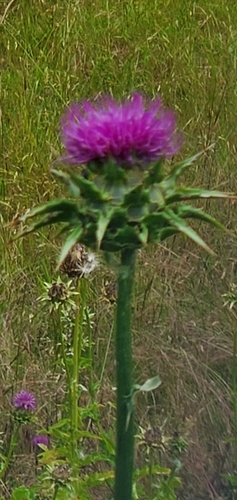
Silybum, Genus, marianum, Species,
- Genus & species
milk thistle
Mediterranean Europe, northern Africa, western Asia
Overview
Silybum marianum is a stout, erect annual or biennial in the daisy family (Asteraceae) reaching 24-72 inches (60-180 cm) tall with a 24-48 inch (60-120 cm) spread. Stems are erect, stout, branching, smooth to slightly hairy. Leaves are the primary identification feature: glossy, dark green with conspicuous white marbling (variegation) along the veins, deeply pinnately lobed, spiny-margined with stout yellowish spines up to 0.4 inch (10 mm) long. Basal rosette leaves are 12-24 inches (30-60 cm) long. The white vein marbling pattern is rare among common thistles and is immediately diagnostic. Flower heads are solitary, 1.5-2.5 inches (4-6 cm) in diameter, with purple to pink disc florets and no ray florets. The involucre has broad, spine-tipped phyllaries that spread outward and downward. Fruit is an achene 0.2-0.3 inch (5-7 mm) long with a white pappus. A single plant produces 5,000-20,000 seeds. Seeds contain silymarin, a flavonoid complex used in herbal medicine for liver support. Listed as a Class A noxious weed in Washington State (limited distribution, high priority for eradication).
Native Range
Silybum marianum is native to Mediterranean Europe, northern Africa, and western Asia, occurring in roadsides, waste ground, pastures, and disturbed sites from sea level to approximately 5,000 feet (1,500 m). Widely naturalized in California and at scattered locations in the Pacific Northwest, the species is listed as Class A in Washington State due to its limited distribution and the priority for eradication.Suggested Uses
Used in noxious weed identification courses for the Class A (eradication priority) category and the rare white-marbled leaf pattern. The thistle comparison set covers four genera: Cirsium (no wing, no marbling), Onopordum (spiny-winged woolly), Carduus (no wing, nodding), and Silybum (white-marbled). Seeds are the commercial source of silymarin (milk thistle extract), used as a liver support supplement and studied in hepatoprotective pharmacology. The white vein marbling is studied in leaf pigmentation genetics. S. marianum is a regulated Class A noxious weed in Washington State and is not planted horticulturally.How to Identify
Appearance
Size & Dimensions
Height2' - 6'
Width/Spread2' - 4'
Bloom Information
Flowers appear May through August. Large solitary heads bloom over 3-4 weeks. Pollinated by bees and butterflies. Seeds mature 4-6 weeks after flowering. In the Pacific Northwest, the limited distribution means new sightings are reported to county noxious weed boards.
Detailed Descriptions
Flower Description
Purple to pink solitary heads 1.5-2.5 inches (4-6 cm) with broad spine-tipped phyllaries spreading outwardFoliage Description
Glossy dark green with conspicuous white marbling along the veins; spiny-margined; large, deeply lobedGrowing Conditions
Sun Requirements
Requires 6-12 hours of direct sunlight daily
• Full Sun: 6+ hours of direct sunlight
• Partial Shade: 3-6 hours of direct sunlight
• Full Shade: Less than 3 hours of direct sunlight