Sida, Genus, rhombifolia, Species,
- Genus & species
Cuban jute
Overview
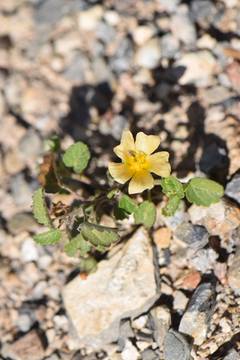
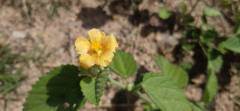
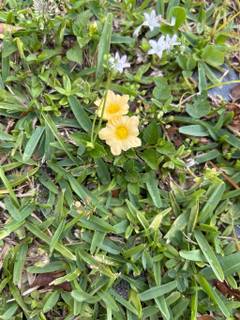
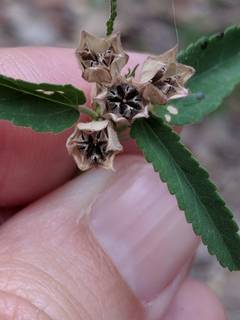
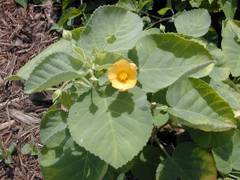
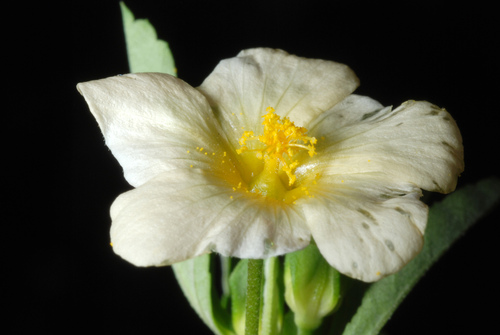
Sida rhombifolia is an erect, woody-based perennial subshrub in the mallow family, growing 1.5-5 ft (0.5-1.5 m) tall from a tough taproot. The wiry, fibrous stems branch in the upper half and have long been stripped for cordage and a jute-like fiber. Alternate leaves are rhombic to lance-shaped, 1-3 in (2.5-8 cm) long, gray-green, and toothed along the outer half, with paler undersides. Pale yellow to orange-yellow flowers, about 0.4-0.6 in (1-1.5 cm) across with five petals, open singly in the leaf axils during the warmth of midday and close by evening. Flowering continues through much of the warm season wherever frost is absent. The fruit is a ring-shaped cluster of segments (mericarps), each tipped with two short awns that cling to fur and clothing for dispersal. The plant grows on roadsides, pastures, waste ground, and disturbed soils across the tropics and subtropics, and is treated as a weed in grazing land because livestock avoid its bitter, fibrous stems. It tolerates poor soil, heat, and drought, and resprouts from the woody base after cutting. It is sometimes confused with Sida acuta, which has narrower leaves and fruit awns of different length.
Native Range
Sida rhombifolia has a pantropical distribution and its exact origin is uncertain, with tropical Asia and the Americas both proposed as native ground. It now grows throughout warm regions worldwide, on roadsides, pastures, and disturbed land in the tropics and subtropics.Suggested Uses
Sida rhombifolia is grown chiefly as a fiber and traditional medicinal plant rather than as an ornamental, and its stems yield a jute substitute. It appears in informal and ethnobotanical plantings in warm climates. In pastures and crop land it is managed as a weed rather than cultivated.How to Identify
Appearance
Size & Dimensions
Height1'6" - 5'
Width/Spread1' - 3'
Colors
Bloom Information
Flowering continues through most of the warm, frost-free season, peaking in summer and autumn. The pale-yellow flowers open near midday and close by evening, each lasting a single day. Bees and other small insects visit the blooms, which give way to clusters of awned seed segments.
Detailed Descriptions
Flower Description
pale yellow to orange-yellowFoliage Description
gray-greenGrowing Conditions
Sun Requirements
Requires 6-12 hours of direct sunlight daily
• Full Sun: 6+ hours of direct sunlight
• Partial Shade: 3-6 hours of direct sunlight
• Full Shade: Less than 3 hours of direct sunlight
Care & Maintenance
Care Guide
Sida rhombifolia grows in full sun on a wide range of soils, from sandy to clay, and tolerates poor fertility, heat, and drought once its taproot is established. It needs little or no irrigation and grows fastest with warm-season moisture. The species is frost-tender and behaves as an annual where winters are cold, dying back with the first hard freeze. Plants resprout readily from the woody crown after cutting or grazing, which makes established stands persistent. It self-seeds freely on open ground. No feeding is needed on average soils.Pruning
Pruning has little role beyond cutting stems to the base to limit spread, though the woody crown usually resprouts. Cutting or mowing before the awned seeds form reduces self-sowing. Spent stems can be cleared at the end of the warm season.Pruning Schedule
Prune: November
fall