Shibataea, Genus, kumasasa, Species,
- Genus & species
ruscus-leaved bamboo
Japan and eastern China (moist forest understory and woodland edges)
Overview
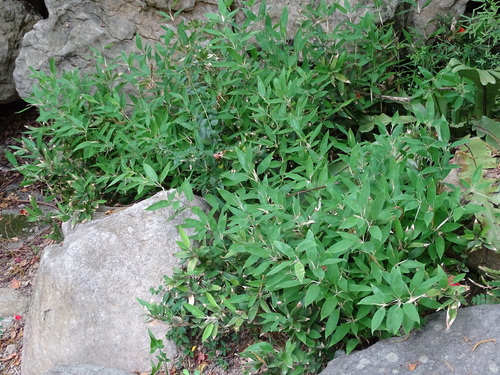
Shibataea kumasasa is an evergreen running bamboo in the grass family (Poaceae) reaching 3–5 feet (0.9–1.5 m) tall with a spread of 4–8 feet (1.2–2.4 m) from slender underground rhizomes. The habit is low, dense, and bushy on thin flattened culms 0.25 inch (6 mm) in diameter that grow in a zigzag pattern. Native to Japan and eastern China, the species occurs in moist forest understory and at woodland edges, and the genus honors Japanese botanist Keita Shibata. Leaves are short, broad, and ovate at 2–4 inches (5–10 cm) long × 0.75–1.5 inches (2–4 cm) wide, a length-to-width ratio of roughly 2.5:1 that sets this bamboo apart from the 5:1 or greater ratios common in most cultivated bamboos; the broad leaf shape is similar to Ruscus aculeatus and gives the common name 'Ruscus-leaved bamboo'. Growth rate is slow to moderate, with rhizomes extending 6–12 inches (15–30 cm) per year in moist humus-rich sheltered sites — much slower than Phyllostachys at 24 or more inches (60+ cm). Hardy to zone 6. Flowering is rare and unpredictable; decades may pass between flowering events. Running rhizomes spread continuously, so a root barrier at least 24 inches (60 cm) deep is required for long-term containment.
Native Range
Shibataea kumasasa is native to Japan and eastern China, where it grows in moist forest understory and at woodland edges. The genus was named for Japanese botanist Keita Shibata (1877–1949).Suggested Uses
Grown as a low screening hedge at 3–5 feet (0.9–1.5 m) height, as a woodland groundcover, and as a container specimen at 3–4 foot (0.9–1.2 m) spacing. Shade tolerance suits woodland edge plantings under high canopy where most bamboos become thin. Container culture requires 10 gallon (38 L) or larger pots with well-drained mix. Dry sites, full sun in hot climates, and any ground-level planting without a rhizome barrier where spread is not wanted produce poor results or unwanted colonization.How to Identify
Appearance
Size & Dimensions
Height3' - 5'
Width/Spread4' - 8'
Bloom Information
Bamboo flowering is rare and unpredictable; decades may pass between flowering events at the species level. Flowers are inconspicuous grass-like spikelets. Foliage and culm structure are the year-round ornamental features; flowering is not part of normal garden display.
Detailed Descriptions
Foliage Description
Dark green, short broad ovate 2-4 inches long by 0.75-1.5 inches wide (length-to-width ratio near 2.5:1)Growing Conditions
Sun Requirements
Requires 2-6 hours of direct sunlight daily
• Full Sun: 6+ hours of direct sunlight
• Partial Shade: 3-6 hours of direct sunlight
• Full Shade: Less than 3 hours of direct sunlight
Care & Maintenance
Care Guide
Grows in partial shade to full shade in moist humus-rich well-drained soil at pH 5.5–7.0. Hardy to zone 6. Shade tolerance is higher than most cultivated bamboos; full sun in hot dry climates causes leaf scorch. Mulching the root zone 2–3 inches (5–7.5 cm) deep with bark or leaf mould maintains soil moisture and moderates root temperature. Running rhizomes spread continuously; a root barrier 24 inches (60 cm) deep, or a contained bed with hard edges, prevents spread into adjacent plantings. Cold drying winter winds cause foliage desiccation in zones 6–7.Pruning
Remove old, thin, or damaged culms at ground level in early spring (March–April) as new shoots emerge. Cut any emerging rhizomes at the chosen boundary line with a sharp spade to contain spread; this is done annually in spring and fall. The low bushy habit develops without heading cuts.Pruning Schedule
Prune: March–April
early spring
Container Growing
Suitable for container growing
Minimum container size: 10 gallons