Shepherdia, Genus, argentea, Species,
- Genus & species
silver buffaloberry
Prairies and Intermountain West of North America
Overview
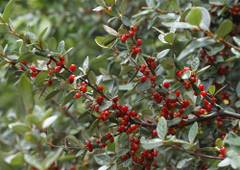
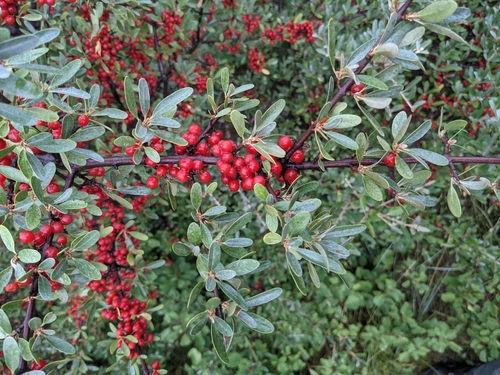
Shepherdia argentea is a deciduous, thorny, nitrogen-fixing shrub or small tree reaching 6-20 feet (1.8-6 m) tall and 6-15 feet (1.8-4.5 m) wide, often forming dense suckering thickets in moist alkaline soils. Leaves are opposite, oblong to lance-shaped, 1-2 inches (2.5-5 cm) long, silvery-grey on both surfaces from a dense covering of stellate hairs that flake off slightly with age. Stems are armed with stout single thorns 0.4-1 inch (10-25 mm) long arising from leaf axils on second-year growth. Plants are dioecious; small inconspicuous yellow-green flowers open before leaf-out in March through May. Female plants bear red to orange-red drupes 0.2-0.3 inches (5-8 mm) across in July and August, persisting on the shrub through autumn until eaten by birds. Fruits are tart, edible raw or in jellies, and contain a single hard seed. Nitrogen fixation occurs in root nodules colonized by Frankia bacteria; plants improve adjacent soil nitrogen levels by 30-60 percent over 5-10 years on degraded sites. Suckering habit and persistent thorns make removal labor-intensive once established.
Native Range
Native to the prairies, Great Plains, and intermountain West of North America from Saskatchewan and Alberta south through the Dakotas, Nebraska, Wyoming, Idaho, Utah, and Nevada to northern New Mexico. Grows along streambanks, in moist alkaline meadows, on degraded rangeland, and in roadside ditches at 1,500-7,500 feet (450-2,300 m) elevation.Suggested Uses
Planted in shelterbelts, windbreaks, riparian restoration, soil-improvement plantings, and wildlife habitat zones in zones 2-7. Spaced 6-10 feet (1.8-3 m) apart in shelterbelt rows; tighter spacing produces dense thickets within 5 years. Suckering habit and thorns make the species unsuitable for small lots, formal gardens, and lawn-edge plantings, where it spreads into adjacent areas within 5-7 years.How to Identify
Appearance
Size & Dimensions
Height6' - 20'
Width/Spread6' - 15'
Bloom Information
March through May across the range; begins late February in the southern part of the range and extends into early June in the northern Plains. Flowers open before leaves emerge and last 2-3 weeks. Female plants must be near male plants for fruit set; isolated females rarely produce fruit. Pollination is primarily by wind and small bees.
Detailed Descriptions
Foliage Description
Silvery-greyGrowing Conditions
Sun Requirements
Requires 6-12 hours of direct sunlight daily
• Full Sun: 6+ hours of direct sunlight
• Partial Shade: 3-6 hours of direct sunlight
• Full Shade: Less than 3 hours of direct sunlight
Care & Maintenance
Care Guide
Plant container or bare-root stock in spring or fall; the species establishes readily on degraded sites with minimal soil amendment. Tolerates alkaline soils to pH 8.5, salinity to 4 dS/m, periodic flooding, and drought once roots reach 24-36 inches (60-90 cm) deep. Suckering from lateral roots produces dense thickets within 5-10 years; root barriers or routine sucker removal limits spread in landscape settings. Verticillium wilt occasionally causes branch dieback in poorly drained sites. Both male and female plants are needed for fruit production; sex is determined by flower morphology and is fixed at maturity. Few pests trouble the species in the native range. Container-grown plants resent root disturbance; transplants larger than 5 gallons frequently establish slowly or fail.Pruning
Cut suckers at the soil line in early spring before leaf-out to limit spread in landscape settings. Renewal pruning of one-third of the oldest stems annually maintains a productive shrub form; older stems become brittle and bear less fruit after 12-15 years. Heavy pruning in summer triggers vigorous regrowth from the base.Pruning Schedule
Prune: March–April
early spring