Sequoia, Genus, sempervirens, Species,
- Genus & species
redwood
Pacific coast of North America (southwestern Oregon to central California)
Overview
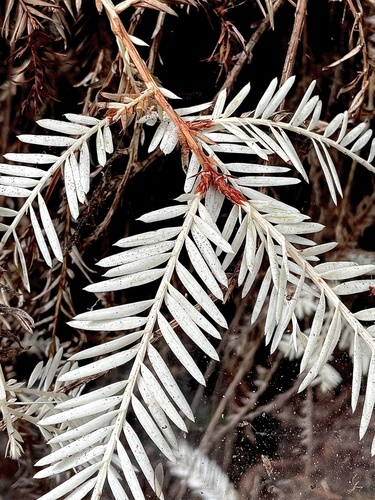
Sequoia is a genus of evergreen conifers in the cypress family (Cupressaceae), now represented by a single living species, S. sempervirens, the coast redwood. Mature trees reach 60–115 m (200–380 ft) tall, with trunk diameters of 3–7 m (10–23 ft) and a straight, columnar bole clad in thick, fibrous reddish-brown bark 15–30 cm (6–12 in) deep. The crown is conical in youth and irregular with age. Foliage is dimorphic: flattened, two-ranked needles 15–25 mm (0.6–1 in) long on shaded shoots, and shorter, scale-like awl-shaped leaves on cone-bearing and upper-canopy shoots. Trees are monoecious, carrying small pollen cones and woody seed cones 15–35 mm (0.6–1.4 in) long that ripen in a single season. Sequoia regenerates from seed and, unlike most conifers, resprouts from basal burls and cut stumps. Lifespans exceed 2,000 years on favourable sites. The genus is restricted to a narrow coastal fog belt and depends on summer fog drip to offset dry-season rainfall, so it grows poorly in hot, arid, or continental climates. Height increases of 0.3–1 m (1–3 ft) per year are common on young trees where moisture is reliable.
Native Range
Sequoia sempervirens is native to a narrow coastal strip of western North America, from extreme southwestern Oregon south through the Coast Ranges of California to Monterey County. It occupies fog-influenced lowlands and slopes within about 50 km (30 mi) of the Pacific Ocean, generally below 900 m (3,000 ft).Suggested Uses
Used as a large specimen and shade tree in parks, arboreta, and spacious landscapes within its climate range. Planted in groves for screening and windbreaks where vertical and lateral space is ample. Too large for small residential lots and confined planting sites.How to Identify
Appearance
Size & Dimensions
Height200' - 380'
Width/Spread20' - 40'
Bloom Information
As a conifer, Sequoia produces cones rather than flowers. Pollen cones shed pollen in late winter, generally December to February. The wind-pollinated seed cones mature within a single growing season, ripening and shedding seed in autumn.
Detailed Descriptions
Foliage Description
dark greenGrowing Conditions
Sun Requirements
Requires 6-12 hours of direct sunlight daily
• Full Sun: 6+ hours of direct sunlight
• Partial Shade: 3-6 hours of direct sunlight
• Full Shade: Less than 3 hours of direct sunlight
Care & Maintenance
Care Guide
Grow Sequoia in deep, moist, well-drained loam with consistent moisture and high atmospheric humidity. It takes full sun to part shade and tolerates fog, coastal wind, and brief seasonal flooding, but declines in hot, dry, or strongly continental climates. Soil pH from about 5.0 to 7.5 suits it, and mulching keeps the roots cool and moist. Established trees withstand short droughts but shed lower foliage and slow without summer moisture. Hardiness spans roughly USDA zones 7 to 9. The shallow, wide-spreading root system needs ample lateral room and is not suited to confined urban planting pits.Pruning
Sequoia needs little pruning and develops its columnar form without intervention. Remove dead, damaged, or crossing branches in late winter to early spring. Severe topping destroys the natural form and produces weak watersprout regrowth. Lower branches may be raised gradually to expose the trunk.Pruning Schedule
Prune: February–March
winter
