Image 1 of 11
1 / 11
Plant Reference
Sequoia, Genus, sempervirens, Species,
- Genus & species
coast redwood
Native to the Pacific coastal strip of western North America from southwestern Oregon south through California to the Santa Lucia Mountains of Monterey County, in a narrow 450-mile (720 km) coastal strip within the summer fog belt from sea level to 3,000 feet (900 m) elevation
Overview
Sequoia sempervirens is coast redwood (California redwood), the tallest tree species on Earth — the record specimen Hyperion, a tree in Redwood National and State Parks of northern California, measures 380.3 feet (115.9 m) tall as of the most recent survey and represents the verified world-record tree height of any species. In cultivation specimens commonly reach 60-100 feet (18-30 m) tall and 15-25 feet (4.6-7.6 m) wide across a 20-50 year growth period, with continued height accrual over subsequent centuries on productive sites. The species is the sole living member of the genus Sequoia (a monotypic genus in the cypress family Cupressaceae), and the species name sempervirens is from Latin semper (always) and vivere (to be alive or green), recording the evergreen foliage habit. Needles are dark green, flat, linear, 0.5-1 inch (12-25 mm) long, and arranged in two flat ranks along the lateral shoots, with scale-like foliage on the leader shoots — the dual foliage pattern (2-ranked needles on lateral shoots, scale-like on leaders) is a species-level diagnostic. The bark is the species' signature secondary ornamental feature: deeply furrowed, fibrous, reddish-brown, and 6-12 inches (15-30 cm) thick on mature trunks, with the substantial bark thickness insulating the living cambium from wildfire — the thick fire-resistant bark is one of the adaptations that supports the species' documented multi-century lifespans (living specimens exceeding 2,000 years have been dated in old-growth stands). The species' regeneration biology separates it from nearly all other coniferous tree species: coast redwood resprouts vigorously from the base after fire, windthrow, or cutting, producing circles of new stems (fairy rings) around the dead parent stump from dormant buds in the basal burl tissue, and individual genetic clones persist through multiple cycles of stem death and basal regrowth over millennia. The native range is restricted to a 450-mile (720 km) Pacific coastal strip within the summer fog belt from southwestern Oregon south to Monterey County, California, and the coastal fog drip that condenses on the foliage and drips to the soil supplies 30-40% of the trees' annual moisture budget in the native range — the dependence on summer fog moisture is the primary reason the species is restricted to the coastal strip and does not occupy interior habitats despite the apparent climatic suitability of inland Pacific Northwest sites. The species is not to be confused with Sequoiadendron giganteum (giant sequoia or Sierra redwood), a related but separate genus species native to the western slope of the Sierra Nevada that is more massive in trunk volume but shorter in maximum height. Heartwood is highly rot-resistant and insect-resistant, and supplied the primary construction lumber for coastal California settlement in the late 19th and early 20th centuries before logging restrictions and redwood parkland designations reduced the timber harvest. Non-toxic. Deer-resistant.
Native Range
Native to the Pacific coastal strip of western North America — southwestern Oregon south through California to the Santa Lucia Mountains of Monterey County — in a narrow 450-mile (720 km) coastal strip within the summer fog belt from sea level to 3,000 feet (900 m) elevation. The coastal fog drip that condenses on the foliage and drips to the soil supplies 30-40% of the trees' annual moisture budget in the native range. The record specimen Hyperion stands in Redwood National and State Parks, northern California, at 380.3 feet (115.9 m) — the world-record tree height of any species. The species name sempervirens is from Latin semper (always) and vivere (to be alive or green).Suggested Uses
Retained as a native specimen tree on Pacific Northwest and northern California landscapes in zones 7-10 with adequate vertical and lateral space for the species' very large mature size, as a component of large-scale naturalistic plantings in arboreta, parks, and botanical gardens, and as a windbreak or screen planting on moist acidic-soil sites at 25-35 foot (7.6-10.7 m) spacing between trees. The species' standing as the tallest tree species on Earth (world-record Hyperion at 380.3 feet / 115.9 m), the deeply furrowed fibrous reddish-brown bark 6-12 inches thick on mature trunks, the dark green 2-ranked evergreen needle foliage on pendulous lateral shoots, the basal resprout regeneration biology not shared by most other coniferous tree species, and the multi-century lifespans documented in the native range combine to make Sequoia sempervirens a foundation native conifer for large-scale Pacific Northwest and northern California landscapes. Sites restricted in vertical or lateral space are unsuitable because of the species' very large eventual stature. Inland dry-climate positions without supplemental irrigation are unsuitable because the species calls for consistent summer moisture equivalent to the coastal-fog-drip moisture supply of the native range. Container cultivation at landscape dimensions is unsuitable.How to Identify
Appearance
Size & Dimensions
Height60' - 100'
Width/Spread15' - 25'
Reproduction
Male pollen cones are small, yellowish, carried at the branch tips in winter through early spring across a several-week wind-pollinated release period. Female seed cones are small oval structures 0.75-1 inch (18-25 mm) long that mature within one growing season (shorter than the two-year maturation of many cone-bearing genera) and release winged seeds from open cone scales. Seed viability in wild populations is low relative to the seed output, and most regeneration in the native range occurs through basal burl resprouting rather than through seed establishment — the basal regeneration mode is not shared by most other coniferous tree species.
Detailed Descriptions
Foliage Description
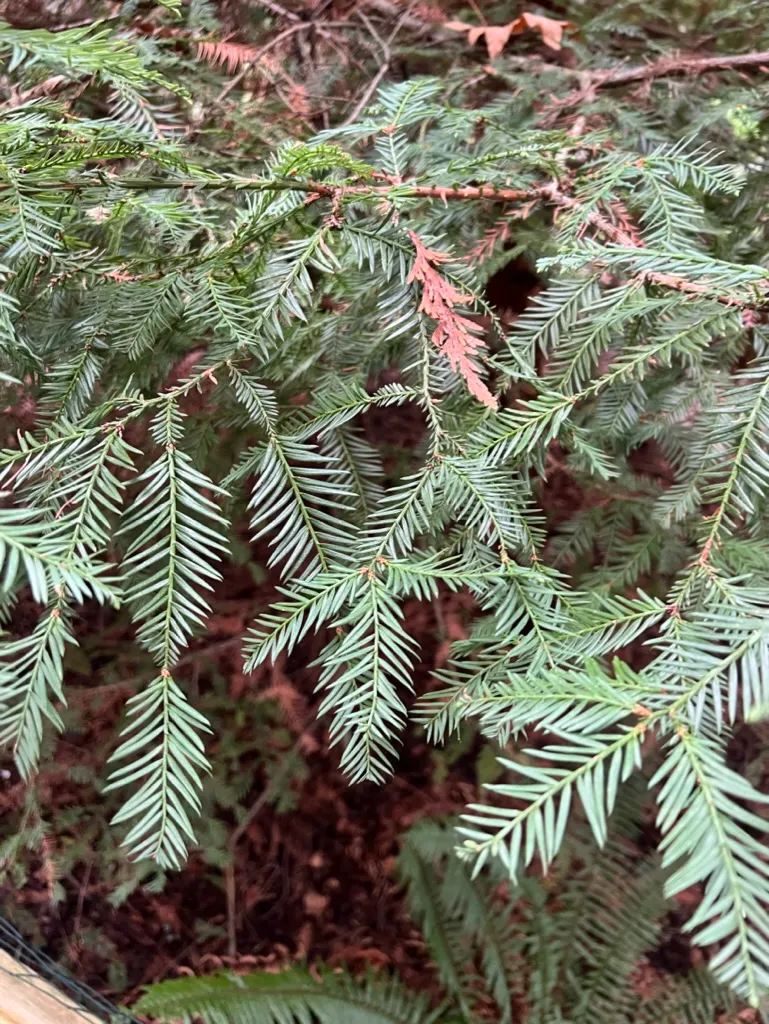
dark green, flat, linear needles 0.5-1 inch (12-25 mm) long arranged in two flat ranks along the lateral shoots and scale-like on leader shoots; the 2-ranked foliage pattern on lateral shoots and the scale-like foliage on leader shoots is a species-level diagnostic of Sequoia sempervirens; evergreen year-round with individual needles retained 3-4 years before shedding and the shed needles accumulating as a litter layer under the canopyGrowing Conditions
Sun Requirements
Requires 4-10 hours of direct sunlight daily
• Full Sun: 6+ hours of direct sunlight
• Partial Shade: 3-6 hours of direct sunlight
• Full Shade: Less than 3 hours of direct sunlight