Schinus, Genus, terebinthifolia, Species,
- Genus & species
Brazilian pepper
South America (Brazil, Argentina, Paraguay)
Overview
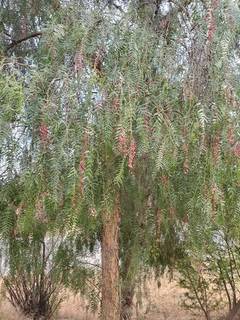
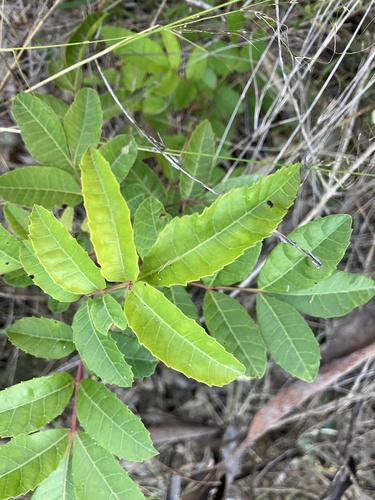
Schinus terebinthifolia is an evergreen shrub or small tree native to South America, reaching 15-30 feet (4.5-9 m) tall with a broad, often multi-stemmed crown. The compound leaves have three to thirteen oblong leaflets along a slightly winged central stalk and release a turpentine-like scent when crushed. Small white flowers are borne in branched clusters in autumn, the male and female flowers on separate plants. Female trees produce dense clusters of glossy red berries about 0.2 inch (5 mm) wide that ripen in winter and persist on the branches. S. terebinthifolia was introduced as an ornamental and has become a widespread invasive woody plant in Florida, Hawaii, Texas, and parts of California, where it is prohibited or regulated. It forms dense thickets that shade out native vegetation, spreading by bird-dispersed seed and by root and stump sprouts. The sap, leaves, and fruit contain irritant compounds related to those in poison ivy and can cause skin rashes and respiratory irritation. It tolerates drought, flooding, salt, and poor soil. Growth is rapid, and cut or damaged plants resprout vigorously.
Native Range
Schinus terebinthifolia is native to southeastern Brazil, northern Argentina, and Paraguay. In North America it has naturalized across central and southern Florida, coastal Texas, Hawaii, and parts of California, invading hammocks, wetlands, roadsides, and disturbed ground.Suggested Uses
S. terebinthifolia was formerly planted as an ornamental and shade shrub for its red winter fruit. Its sale, transport, and planting are now prohibited in Florida and restricted in other states under invasive-species laws. It is no longer used for landscaping within its invaded range.How to Identify
Appearance
Size & Dimensions
Height15' - 30'
Width/Spread15' - 30'
Bloom Information
S. terebinthifolia flowers mainly from September to November, with the white flowers in branched clusters. Plants are either male or female, so only female trees set fruit. Red berries ripen from late autumn into winter and may persist into spring.
Detailed Descriptions
Foliage Description
dark green, aromaticGrowing Conditions
Sun Requirements
Requires 6-12 hours of direct sunlight daily
• Full Sun: 6+ hours of direct sunlight
• Partial Shade: 3-6 hours of direct sunlight
• Full Shade: Less than 3 hours of direct sunlight