Schinus, Genus, spp., Multiple species,
- Genus
- Multiple species
peppertrees
South America (Brazil, Argentina, Peru, Bolivia, Paraguay, Uruguay)
Overview
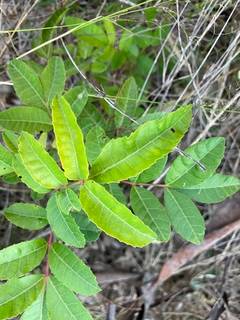
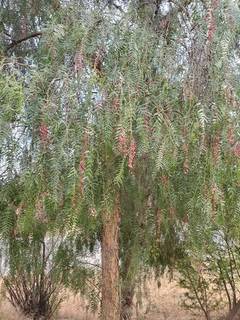
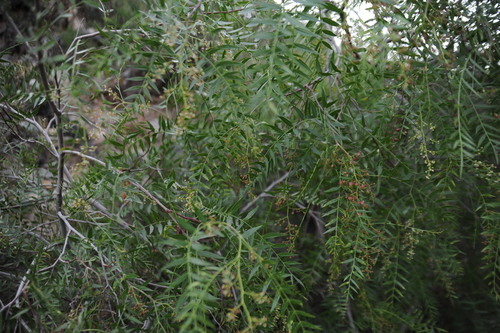
Schinus is a genus of about 30 evergreen trees and shrubs in the cashew family (Anacardiaceae), the peppertrees, native to South America. Plants range from large shrubs to trees 25-50 ft (7.6-15 m) tall, often with arching or weeping branches and aromatic, resin-scented foliage. Leaves are usually pinnately compound with many narrow leaflets, as in S. molle, or fewer broad, glossy leaflets, as in S. terebinthifolia. Small greenish-white to cream flowers crowd into branched clusters, and the plants are mostly dioecious, so only female trees carry the rounded pink to red berry-like drupes 0.2 in (5 mm) across that ripen in autumn and winter. The dried fruits of S. molle are sold as pink peppercorns. The genus tolerates heat and drought and grows fast on poor soils, but S. molle and S. terebinthifolia have naturalized aggressively and are listed as invasive in Florida, California, Hawaii, Australia, and South Africa. Sap and crushed foliage can cause skin irritation, as the family includes poison ivy and its relatives.
Native Range
Schinus is native to South America, with species spread through Brazil, Argentina, Peru, Bolivia, Paraguay, and Uruguay in habitats from dry scrub to subtropical forest. S. molle comes from the Andes of Peru and neighboring countries, and S. terebinthifolia from coastal and inland Brazil. Both have naturalized far beyond their native range and are regulated as invasive in several warm regions.Suggested Uses
S. molle is grown as a shade and street tree in dry, frost-free regions and yields pink peppercorns from its dried fruit, while ornamental use of S. terebinthifolia is restricted or banned where it is invasive. The trees give quick shade and tolerate harsh urban sites. Planting is discouraged in regions where peppertrees escape into wild land.How to Identify
Appearance
Size & Dimensions
Height10' - 50'
Width/Spread10' - 40'
Bloom Information
Schinus flowers mainly in spring and summer, with some flowering through the year in frost-free climates. The small greenish-white flowers are carried in branched sprays and draw bees and other small insects. Female plants follow with hanging clusters of pink to red fruits that persist into winter.
Detailed Descriptions
Flower Description
Greenish-white to creamFoliage Description
Green to glossy dark greenGrowing Conditions
Sun Requirements
Requires 6-10 hours of direct sunlight daily
• Full Sun: 6+ hours of direct sunlight
• Partial Shade: 3-6 hours of direct sunlight
• Full Shade: Less than 3 hours of direct sunlight