Salsola, Genus, tragus, Species,
- Genus & species
prickly Russian thistle
Overview
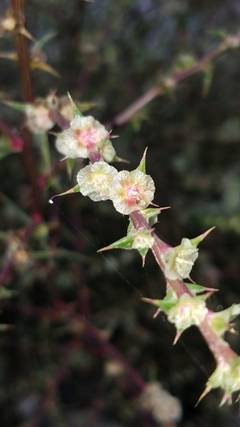
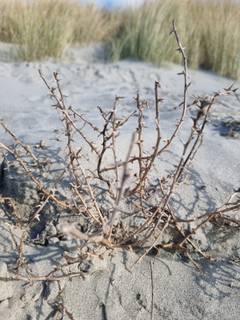
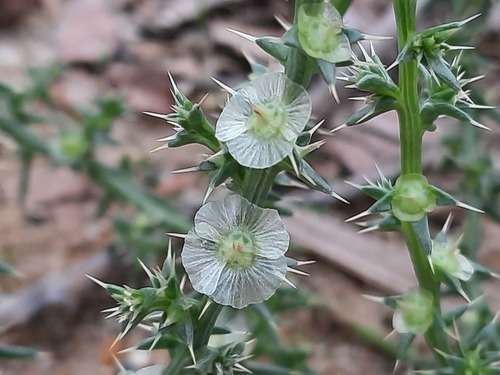
Salsola tragus, prickly Russian thistle or tumbleweed, is a bushy summer annual in the amaranth family, forming a rounded plant 1-3 feet (30-90 cm) tall and wide. Young plants have soft, thread-like leaves, but as they mature the leaves become short, stiff, and spine-tipped, and the stems often show red or purple stripes. Small, inconspicuous greenish flowers form in the leaf axils in summer and fall, each backed by papery, sometimes pink-tinged bracts. After the plant dies and dries, the stem snaps off at the base, and the whole skeleton tumbles in the wind, scattering tens of thousands of seeds as it rolls. Native to the steppes of Eurasia, it has naturalized across the western United States and other dry regions, where it colonizes farmland, roadsides, and disturbed ground and is listed as a noxious weed in several states. It tolerates drought, heat, and saline soils but needs open, bare ground to establish. S. tragus has no garden use and is managed as an agricultural and rangeland weed.
Native Range
Salsola tragus is native to the dry steppes and deserts of Eurasia, from eastern Europe across central Asia. It has naturalized throughout the western and central United States and other arid and semi-arid regions worldwide. It grows on disturbed, open ground such as fields, roadsides, and overgrazed range.Suggested Uses
Salsola tragus has no horticultural use and is treated as an invasive agricultural and rangeland weed. Young plants are occasionally grazed by livestock before the foliage turns spiny. Land managers focus on controlling it to protect crops, range, and roadways.How to Identify
Appearance
Size & Dimensions
Height1' - 3'
Width/Spread1' - 3'
Bloom Information
Detailed Descriptions
Flower Description
Greenish with pink-tinged bractsFoliage Description
GreenGrowing Conditions
Sun Requirements
Requires 6-12 hours of direct sunlight daily
• Full Sun: 6+ hours of direct sunlight
• Partial Shade: 3-6 hours of direct sunlight
• Full Shade: Less than 3 hours of direct sunlight
Water & Climate
Water Needs
Drought Tolerance
Drought tolerant when established