Salsola, Genus, spp., Multiple species,
- Genus
- Multiple species
Russian thistles
Eurasia, North Africa, and Australia
Overview
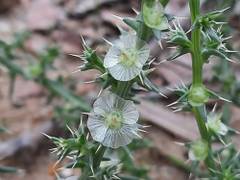
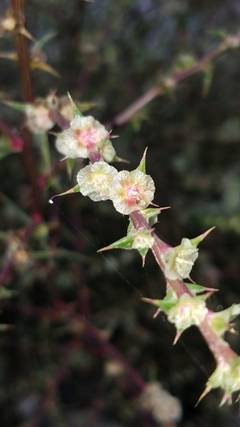
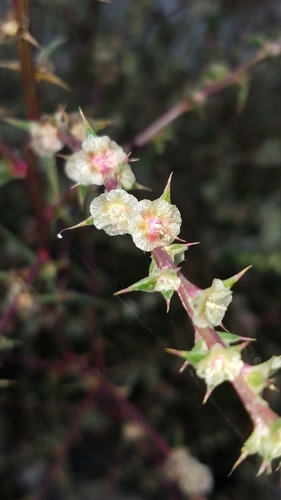
Salsola is a genus of roughly 100 to 130 species of annual herbs and small subshrubs in the amaranth family, Amaranthaceae, distributed across Eurasia, North Africa, and Australia, with several species now naturalized across western North America. Plants form rounded, much-branched mounds 8 to 40 inches (20 to 100 cm) tall and wide, with stems often striped green, red, or purple. Leaves are alternate and narrow, 0.2 to 2 inches (5 to 50 mm) long; in many species they are cylindrical and somewhat fleshy when young and harden to a spine-tipped point as the plant matures. The flowers are small and lack petals, with five greenish to pink papery tepals set among stiff bracts, borne singly in the leaf axils through summer and autumn. After the seed ripens, the dried, rounded plants of species such as S. tragus break off at the stem base and roll in the wind, scattering seed as tumbleweeds. Salsola grows in saline soils, deserts, roadsides, and cultivated fields, tolerating drought and salt that exclude most other plants. Several species are listed as noxious or invasive weeds in the United States and Australia, where windborne plants pile against fences and the dry stems carry fire. The young shoots of some species are grazed by livestock or cooked as a vegetable, and a few are sown to stabilize arid, saline ground.
Native Range
Salsola is native to arid and saline regions of Eurasia, North Africa, and Australia. Several species, including the Russian thistle S. tragus, spread to the Americas, southern Africa, and elsewhere during the 19th and 20th centuries and are now naturalized on dry, disturbed ground.Suggested Uses
A few Salsola species are sown for soil stabilization and forage on arid, saline rangeland. Young plants are sometimes harvested as a cooked green. Most species are managed as weeds rather than grown by choice.How to Identify
Appearance
Size & Dimensions
Height8" - 3'4"
Width/Spread8" - 3'4"
Bloom Information
Flowering runs from summer into autumn, roughly July to October across most of the range. The small, petalless flowers open in the leaf axils and are pollinated by wind. Seed ripens through autumn, after which the dried plants of tumbleweed species scatter it as they roll.
Detailed Descriptions
Flower Description
greenish to pinkFoliage Description
green, often tinged red or purpleGrowing Conditions
Sun Requirements
Requires 6-12 hours of direct sunlight daily
• Full Sun: 6+ hours of direct sunlight
• Partial Shade: 3-6 hours of direct sunlight
• Full Shade: Less than 3 hours of direct sunlight
Water & Climate
Water Needs
Drought Tolerance
Drought tolerant when established
Care & Maintenance
Care Guide
Salsola species grow in full sun on dry, well-drained soils and tolerate salinity, heat, and long drought. They establish from seed on bare, disturbed ground and need no added water once germinated. Most species complete their life cycle in a single season, setting heavy seed before dying back in autumn. Several are regulated as noxious weeds, so cultivation is restricted in parts of North America and Australia. Where plants appear as volunteers, they are usually cut or pulled before seed set to limit spread. The young, fleshy shoots of some species are edible after cooking.Pruning
Pruning is not part of growing Salsola, as the plants are annual and short-lived. Where they are managed as weeds, plants are cut or pulled before flowering to prevent seed dispersal. Removing them before the stems dry and detach reduces the spread of tumbleweed species.Toxicity: Not assessed
UnknownPlanting Guide
Planting Methods & Timing
Planting Method
direct sow
Direct Sow Timing
Spring, on bare or disturbed ground
Days to Maturity
90–150 days
Plant Spacing
18 inches