Sagittaria, Genus, latifolia, Species,
- Genus & species
wapato
Overview
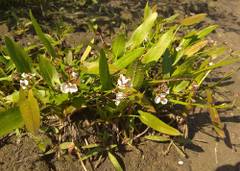
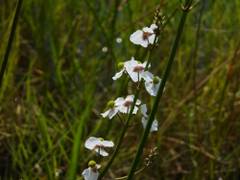
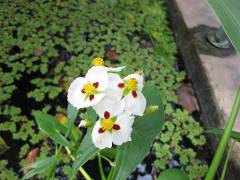
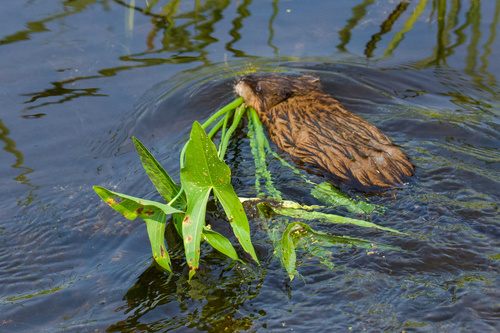
Sagittaria latifolia is an emergent aquatic perennial reaching 1-4 feet (30-120 cm) tall above the water surface, with submerged or floating leaves on stems rising from a tuberous rootstock. Aerial leaves are sagittate (arrow-shaped), 4-12 inches (10-30 cm) long with two pointed basal lobes pointing downward, held on long petioles above the water. Submerged leaves, when present in deeper water, are linear and ribbon-like. White flowers 1 inch (2.5 cm) across appear in whorls of three on upright stalks from June through September; each flower has three rounded petals and a yellow center. Plants are monoecious — staminate (male) flowers occupy the upper whorls and pistillate (female) flowers occupy the lower whorls of the same stalk. After flowering, dense clusters of flat, winged achenes form spherical seedheads about 0.75-1 inch (2-2.5 cm) across that ripen August through October. Below the water, stolons produce starchy tubers 1-2 inches (2.5-5 cm) across late in the growing season; tubers overwinter in mud and resprout in spring. Foliage dies back after the first hard frost in zones 4-7. Spreads by stolons in 6-18 inches (15-45 cm) of standing water and can form dense colonies that crowd out smaller emergent plants in confined ponds.
Native Range
Native to wetlands across North America from southern Canada (British Columbia to Quebec) south through most of the United States to northern Mexico, with disjunct populations in northern South America. Found in slow-moving freshwater margins of ponds, marshes, lake shallows, and stream backwaters at elevations from sea level to about 5,000 feet (1,500 m).Suggested Uses
Used in pond margins, water gardens, and stormwater retention basins for shoreline stabilization and wildlife habitat. Spaced 12-24 inches (30-60 cm) apart in shallow planting baskets with heavy clay or loam topped with gravel. Tubers historically harvested as a starch food by Indigenous peoples across North America.How to Identify
Appearance
Size & Dimensions
Height1' - 4'
Width/Spread1' - 2'
Bloom Information
Flowers June through September across most of the range, with peak bloom in July and August. In the southern range (zones 8-10), flowering may begin in late May. Each flower lasts one day; new flowers open over a 6-10 week period from successive whorls along the flowering stalk.
Detailed Descriptions
Foliage Description
medium greenGrowing Conditions
Sun Requirements
Requires 6-10 hours of direct sunlight daily
• Full Sun: 6+ hours of direct sunlight
• Partial Shade: 3-6 hours of direct sunlight
• Full Shade: Less than 3 hours of direct sunlight
Care & Maintenance
Care Guide
Establish from tubers planted 2-4 inches (5-10 cm) deep in mud during early spring, in standing water 6-18 inches (15-45 cm) deep. Plants tolerate water levels from 2 inches (5 cm) to 24 inches (60 cm); deeper water produces taller, more vegetative growth and reduced flowering. Full sun produces denser stands and more tubers than partial shade. Tubers may be eaten by muskrats, ducks, and geese, which can reduce stand density in waterfowl habitat. Foliage dies back to the rootstock after the first hard frost; cut stems collapse into the water and decompose. Stands persist many years without intervention but can spread beyond intended planting areas through stolon growth.Pruning
No pruning is required during the growing season. Remove dead foliage from pond margins in late fall to reduce organic accumulation. Thin colonies in spring by lifting and removing tubers if the stand has expanded beyond the desired area.Pruning Schedule
Prune: November
fall
Container Growing
Suitable for container growing
Minimum container size: 5 gallons