Sagittaria, Genus, spp., Multiple species,
- Genus
- Multiple species
arrowheads
Overview
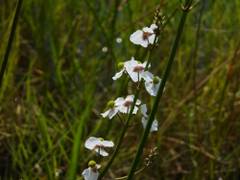
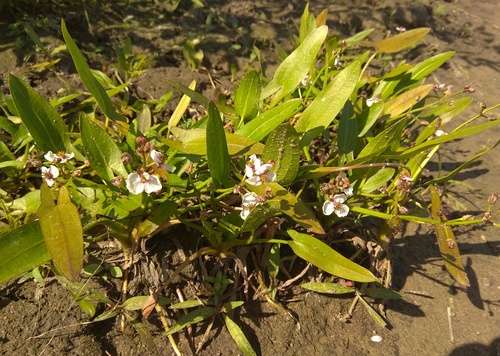
Sagittaria is a genus of about 30 species of aquatic and marginal perennials in the family Alismataceae, distributed across the Americas, Europe, Asia, and Africa, with the greatest concentration of species in North and South America. Plants grow from rhizomes and tubers rooted in mud at pond margins, slow streams, and wetland shallows. Emergent leaves in most species are arrow-shaped, giving the genus its common name, though the submerged and floating leaves of some species are ribbon-like or oval. Leaf blades range from 2-16 inches (5-40 cm) long on long petioles that hold the foliage above the waterline. Flowers open in whorls of three along erect stalks, each bloom with three rounded white petals 0.3-1.2 inches (8-30 mm) across, the upper flowers usually male and the lower female. Plant height across the genus spans 8-48 inches (20-120 cm), depending on species and water depth. Several species, including S. latifolia, form starchy tubers that were a food source for Indigenous peoples of North America. Most species spread by rhizomes and can colonize a pond margin densely, which limits their use in small or formal water features.
Native Range
Sagittaria occurs naturally on every continent except Antarctica, with the highest species diversity in the wetlands of North and South America. S. latifolia ranges across much of North America, while other species occupy temperate and tropical wetlands of Eurasia and Africa.Suggested Uses
Grown at pond margins, in bog gardens, and in wildlife ponds where the emergent foliage and summer flowers rise above shallow water. Tuber-forming species such as S. latifolia are cultivated in water gardens and as a traditional food crop. In natural ponds the genus stabilizes muddy margins and shelters aquatic insects and amphibians.How to Identify
Appearance
Size & Dimensions
Height8" - 4'
Width/Spread1' - 2'
Bloom Information
Across the genus, flowering runs from late spring through summer, roughly June to September in temperate zones. Whorls of white flowers open in sequence up the stalk over several weeks. Bloom timing shifts with water temperature and latitude, and tropical species flower over a longer season.
Detailed Descriptions
Foliage Description
greenGrowing Conditions
Sun Requirements
Requires 6-12 hours of direct sunlight daily
• Full Sun: 6+ hours of direct sunlight
• Partial Shade: 3-6 hours of direct sunlight
• Full Shade: Less than 3 hours of direct sunlight
Water & Climate
Water Needs
Care & Maintenance
Care Guide
Plants need standing or slow-moving water and grow at pond margins, in bog gardens, or in containers submerged 2-12 inches (5-30 cm) above the crown, depending on species. Full sun to part shade suits most species, with heavier flowering in full sun. Soil should be heavy loam or clay loam topped with gravel to anchor the tubers. Temperate species tolerate USDA zones 4-10, while tropical species are limited to frost-free areas. Tubers can be lifted and divided in spring to control spread. In confined water features, vigorous rhizome growth calls for regular thinning.Pruning
Remove yellowing leaves at the base through the growing season to keep the water clear. Cut the clump back in late autumn once the foliage dies down in temperate climates. Lift and divide congested colonies in spring, discarding surplus tubers to limit spread.Container Growing
Suitable for container growing
Minimum container size: 3 gallons