Ruscus, Genus, aculeatus, Species,
- Genus & species
butcher's-broom
Europe, Mediterranean, North Africa, and western Asia
Overview
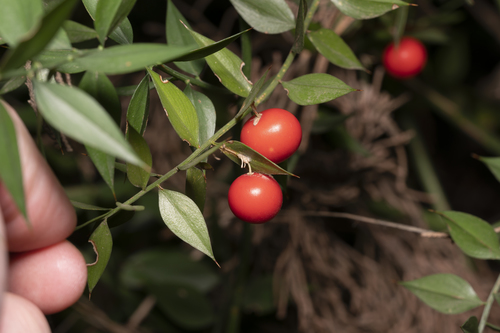
Butcher's-broom is a stiff, evergreen subshrub in the asparagus family, forming upright, much-branched clumps 1.5-3 feet (45-90 cm) tall and 2-4 feet (60-120 cm) wide that spread slowly by rhizomes. What look like small, dark green leaves are flattened, leaf-like stems called cladodes, each oval and tipped with a sharp spine; the true leaves are tiny scales. Small greenish-white flowers appear in the center of the upper surface of each cladode in late winter and spring. The plant is dioecious, so only female plants, with a male nearby, set the round red berries, 0.3-0.5 inch (8-12 mm) across, that ripen in autumn and last into winter. Ruscus aculeatus tolerates deep, dry shade, drought, and poor soil better than most evergreens, which suits it to difficult ground beneath trees. Growth is slow and the spiny cladodes are sharp to handle, the main trade-offs for its toughness. Cut stems are long-lasting and are used in winter arrangements and florist greenery.
Native Range
Native to western and southern Europe, the Mediterranean region, North Africa, and western Asia. Ruscus aculeatus grows in dry woodland, scrub, hedge banks, and rocky ground, often in deep shade.Suggested Uses
Used as an evergreen for dry shade under trees, in woodland gardens, on shaded banks, and as a low, spiny barrier or informal hedge. The cut stems serve as long-lasting florist greenery and in winter arrangements, especially when berried. It also suits native and low-water plantings in mild climates.How to Identify
Appearance
Size & Dimensions
Height1'6" - 3'
Width/Spread2' - 4'
Colors
Bloom Information
Flowers from late winter into spring, with tiny greenish-white flowers set on the face of each cladode. The flowers are easy to overlook and are pollinated by small insects. On female plants with a male nearby, red berries follow and ripen in autumn, holding through winter.
Detailed Descriptions
Foliage Description
dark greenGrowing Conditions
Sun Requirements
Tolerates up to 6 hours of direct sunlight daily
• Full Sun: 6+ hours of direct sunlight
• Partial Shade: 3-6 hours of direct sunlight
• Full Shade: Less than 3 hours of direct sunlight
Care & Maintenance
Care Guide
Grows in part shade to deep shade in well-drained soil of almost any type, with a pH from 6.0 to 7.5, and tolerates full sun in cooler, moister sites. Once established it withstands drought, dry root competition under trees, and neglect, though new plants need water through their first season. It needs no feeding and accepts chalky, sandy, or clay soils alike. Both a male and a female plant are needed for berries, since the sexes are on separate plants. Clumps can be lifted and divided in spring to increase stock or curb their slow spread. It is hardy in milder zones but can be cut back by hard freezes at the cold edge of its range.Pruning
Old, damaged, or berry-spent stems are cut to the ground in early spring, as the plant renews from the base. No shaping is needed, since growth is naturally upright and dense. The spiny stems are awkward to handle where the clump is congested.Container Growing
Suitable for container growing