Ruscus, Genus, spp., Multiple species,
- Genus
- Multiple species
Butcher's broom
Europe, Mediterranean, and western Asia
Overview
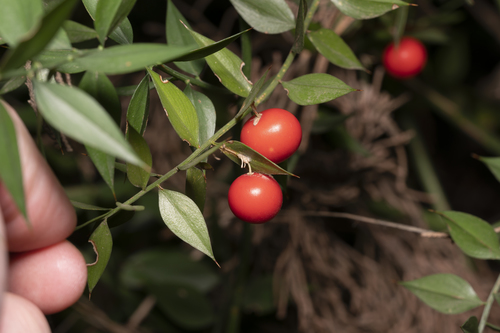
Ruscus is a small genus of evergreen shrubs in the family Asparagaceae, native to western Europe, the Mediterranean, and western Asia. The genus is known for its cladodes, flattened leaf-like shoots that take over photosynthesis, while the true leaves are reduced to tiny scales. Plants form stiff, upright to arching clumps 1-4 ft (0.3-1.2 m) tall that spread slowly by rhizomes. The dark green cladodes are 0.4-3 in (1-8 cm) long and, in several species, end in a sharp spine. Tiny greenish flowers form on the face or edge of each cladode and, on female or self-fertile plants, develop into glossy red berries 0.3-0.5 in (8-12 mm) across that persist through winter. Species grow in dry shade beneath trees and on rocky slopes, tolerating deep shade, drought, and poor soil once established, though growth is slow. Some species spread by seed and creeping rhizomes.
Native Range
Ruscus is native to western and southern Europe, the Mediterranean Basin, North Africa, and western Asia, with outliers on Atlantic islands. Species grow in woodland, scrub, and rocky ground, often in dry shade.Suggested Uses
Grown as a groundcover and low shrub in dry shade, woodland gardens, and difficult sites beneath trees. The berried stems are cut for winter arrangements, and the spiny forms are used as a low barrier planting.How to Identify
Appearance
Size & Dimensions
Height1' - 4'
Width/Spread1' - 4'
Bloom Information
Detailed Descriptions
Foliage Description
dark greenGrowing Conditions
Sun Requirements
Tolerates up to 4 hours of direct sunlight daily
• Full Sun: 6+ hours of direct sunlight
• Partial Shade: 3-6 hours of direct sunlight
• Full Shade: Less than 3 hours of direct sunlight
Care & Maintenance
Care Guide
Ruscus grows in part to full shade on a wide range of soils, including dry, poor, and chalky ground, and tolerates conditions where many plants struggle, such as dry shade under trees. A soil pH near 6.0-8.0 is suitable. Established plants endure drought, deep shade, and neglect, but they are slow to establish and to spread. In some species both male and female plants, or self-fertile forms, are needed for berries. Few pests or diseases affect the genus.Pruning
Cut old, damaged, or yellowing stems to the base in late winter to make room for new shoots from the rhizome. The genus regrows from the base, so whole-stem removal is used rather than trimming individual cladodes.Pruning Schedule
Prune: February
winter
Container Growing
Suitable for container growing
Minimum container size: 3 gallons