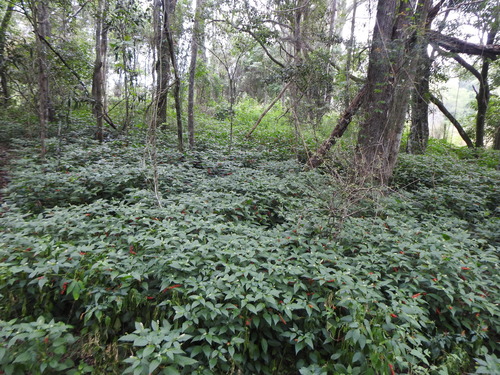
Rivina, Genus, humilis, Species,
- Genus & species
pigeonberry
Southern US, Mexico, Central and South America
Overview
Rivina humilis is an evergreen perennial subshrub of warm regions of the Americas, growing 1-4 feet (30-120 cm) tall with slender, branching, somewhat weak stems. The thin, oval to heart-shaped leaves are 2-4 inches (5-10 cm) long, soft green, and pointed at the tip. The plant flowers nearly year-round in frost-free areas, producing slender racemes of small flowers in white to pink that open along an elongating stalk. Each flower is followed by a small, glossy, translucent red to orange berry about 0.2 inch (5 mm) wide, so that flowers and ripe fruit often appear on the same raceme. The red berries draw birds, which spread the seed widely. R. humilis grows in the shade of woodlands, thickets, and palm groves, on a range of soils, and tolerates dry shade once established. It spreads by seed and can naturalize beyond planted areas in mild climates. The berries and roots contain saponins and are considered mildly toxic if eaten in quantity. The juice of the fruit has been used as a red dye. Growth is moderate, and frost kills the top growth, which regrows from the root in spring.
Native Range
Rivina humilis is native to the southern United States, Mexico, the Caribbean, and Central and South America. It grows in shaded woodlands, thickets, and along fences and palm groves in subtropical and tropical regions.Suggested Uses
R. humilis is used as a groundcover and filler in shaded beds, woodland gardens, and wildlife plantings in mild climates. It suits containers and shaded patios where it can be moved out of frost. Its berries draw songbirds in the autumn garden.How to Identify
Appearance
Size & Dimensions
Height1' - 4'
Width/Spread1' - 3'
Bloom Information
R. humilis blooms nearly year-round in frost-free climates, with peak flowering from spring through fall. The small white to pink flowers open along lengthening racemes, followed quickly by red berries. Flowers and ripe fruit are often present together.
Detailed Descriptions
Flower Description
white to pinkFoliage Description
soft greenGrowing Conditions
Sun Requirements
Requires 2-6 hours of direct sunlight daily
• Full Sun: 6+ hours of direct sunlight
• Partial Shade: 3-6 hours of direct sunlight
• Full Shade: Less than 3 hours of direct sunlight
Care & Maintenance
Care Guide
R. humilis grows in part to full shade and tolerates dry shade once established. It adapts to sandy, loamy, or rocky soils with good drainage and moderate moisture. Water needs are low to moderate; the plant withstands short dry spells but grows fuller with regular water. Hardy in USDA zones 8-11, it dies back after frost and resprouts from the root in spring. In frost-free areas it stays evergreen and flowers year-round. It self-seeds freely, and seedlings can spread into nearby beds.Pruning
R. humilis responds to cutting back leggy stems in spring to keep a fuller shape. Frost-killed top growth is removed once new shoots appear from the base. Spent fruiting stems can be trimmed to limit self-seeding.Pruning Schedule
Prune: March
early spring
Container Growing
Suitable for container growing
Minimum container size: 3 gallons