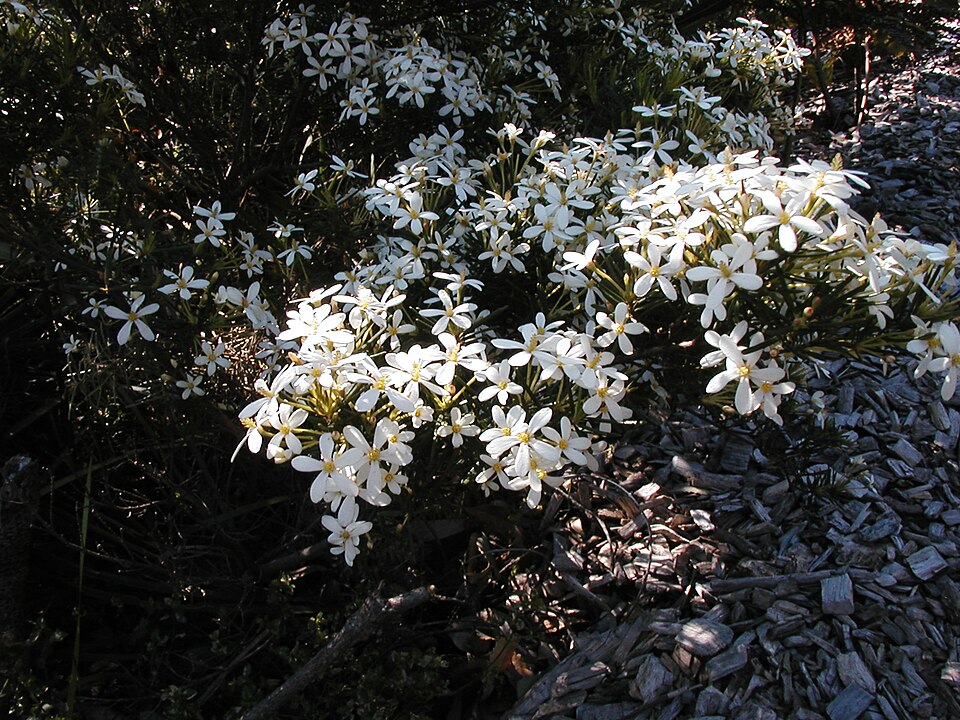
Ricinocarpos, Genus, spp., Multiple species,
- Genus
- Multiple species
wedding bush
Overview
Ricinocarpos is a genus of evergreen shrubs in the spurge family (Euphorbiaceae), with around fifteen to twenty species, most endemic to Australia and a few in New Caledonia. Plants are typically rounded, much-branched shrubs 2-8 ft (0.6-2.4 m) tall, growing in heath, mallee, and dry sclerophyll woodland on sandy or rocky soils. The narrow leaves are 0.4-2 in (1-5 cm) long, often with margins rolled under and a paler, hairy underside. Flowers are white, occasionally pink, with five spreading petals about 0.5-1 in (12-25 mm) across; separate male and female flowers form on the same plant, with several males clustered around a single central female. Flowering is concentrated in late winter and spring and can cover the bush densely. The fruit is a bristly three-lobed capsule that splits to eject the seeds. Like other Euphorbiaceae, the genus carries acrid sap, and species grow on lean, free-draining ground but decline in heavy, wet, or limed soils.
Native Range
Ricinocarpos is centred on Australia, present in every mainland state and Tasmania, with a small number of species in New Caledonia. Plants grow in coastal heath, mallee, and dry woodland on sandy and rocky soils.Suggested Uses
Grown in native, coastal, and low-water gardens as a spring-flowering evergreen shrub, and in rockery and bushland-style plantings on sandy soils. Suited to mass planting on free-draining slopes.How to Identify
Appearance
Size & Dimensions
Height2' - 8'
Width/Spread2' - 6'
Bloom Information
Flowering peaks in late winter and spring, roughly August to November in the native range, often covering the shrub in white bloom. Male and female flowers open together on the same plant, and the display lasts several weeks before dry capsules form.
Detailed Descriptions
Flower Description
white to pinkFoliage Description
greenGrowing Conditions
Sun Requirements
Requires 5-8 hours of direct sunlight daily
• Full Sun: 6+ hours of direct sunlight
• Partial Shade: 3-6 hours of direct sunlight
• Full Shade: Less than 3 hours of direct sunlight
Care & Maintenance
Care Guide
Ricinocarpos grows in full sun to light shade on sharply drained sandy, gravelly, or rocky soils of low fertility. A soil pH near 5.5-6.5 suits the genus, which is sensitive to high phosphorus like many Australian natives. Established plants tolerate dry summers and coastal exposure but fail in heavy, poorly drained, or limed ground. Plants can be slow and exacting to establish and resent root disturbance. Watering is needed mainly during the first season and in extended drought.Pruning
A light tip prune after flowering keeps growth dense and compact. Plants reshoot from younger wood but respond poorly to cutting into old bare stems, so renovation is gradual rather than hard.Pruning Schedule
Prune: November–December
late springsummer
Container Growing
Suitable for container growing
Minimum container size: 5 gallons
