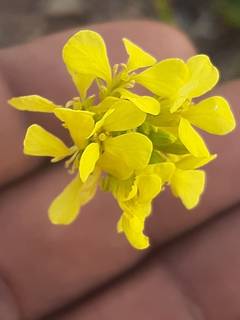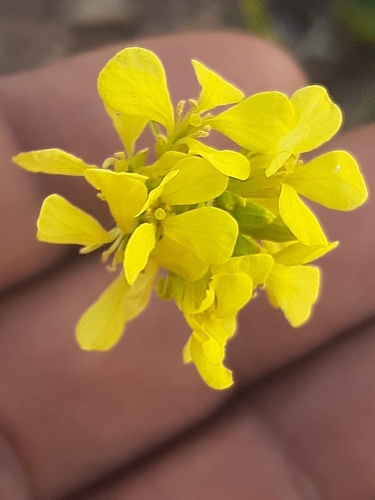
Rapistrum, Genus, spp., Multiple species,
- Genus
- Multiple species
Europe, Mediterranean, North Africa, and western and central Asia
SunFull Sun
Overview
Rapistrum is a small genus of herbaceous plants in the family Brassicaceae, native to Europe, the Mediterranean, and western Asia, with Rapistrum rugosum the most widespread species. Plants are annual to short-lived perennial, growing 1-5 feet (30-150 cm) tall from a basal rosette, with branched, bristly-haired stems. The lower leaves are 2-8 inches (5-20 cm) long, lyre-shaped with a large terminal lobe and smaller side lobes, while upper leaves are smaller and narrower. Yellow flowers about 0.2-0.4 inch (5-10 mm) across have four petals in a cross and are carried in elongating clusters at the stem tips through spring and summer. The fruit is a two-jointed pod: a narrow lower segment topped by a rounded, ribbed upper segment holding one seed, the whole breaking apart at maturity. A single vigorous plant can produce thousands of seeds. Growth is rapid in fertile, disturbed soil, and plants can form dense stands that crowd out low vegetation. Foliage and stems die back after seed set. Several species are naturalized well beyond their native range and behave as agricultural and roadside weeds.
Native Range
Rapistrum is native to Europe, the Mediterranean Basin, North Africa, and western and central Asia. Plants grow in disturbed and cultivated ground, field margins, roadsides, and waste places on fertile, well-drained soils. Rapistrum rugosum has naturalized across North and South America, Australia, and southern Africa, where it spreads along roadsides and into crop fields.Suggested Uses
Rarely planted by choice and encountered mainly as a volunteer in disturbed ground, field edges, and roadsides. Where present in wildflower or forage settings it produces early-season yellow bloom, but its heavy seeding and weedy spread limit deliberate use. Management often focuses on removal before seed set.How to Identify
Appearance
Size & Dimensions
Height1' - 5'
Width/Spread8" - 2'
Bloom Information
Flowers from spring into summer, mainly April through August, with the start depending on whether plants germinate in autumn or spring. Autumn-germinated plants bloom earlier and grow larger. Flowering continues over many weeks as the clusters lengthen, and seed ripens from early summer onward.
Detailed Descriptions
Foliage Description
greenGrowing Conditions
Sun Requirements
Requires 6-10 hours of direct sunlight daily
• Full Sun: 6+ hours of direct sunlight
• Partial Shade: 3-6 hours of direct sunlight
• Full Shade: Less than 3 hours of direct sunlight
Water & Climate
Water Needs
Drought Tolerance
Drought tolerant when established
Care & Maintenance
Care Guide
Plants grow readily from seed on fertile, disturbed, well-drained soil in full sun and need little attention once established. Growth is fastest with moisture and high soil fertility, and plants tolerate short dry periods by maturing quickly. Self-seeding is heavy, and volunteer seedlings appear in large numbers where seed is allowed to drop. Removing plants before the pods ripen limits spread. Flea beetles and cabbage-family pests may feed on the leaves. In many regions Rapistrum rugosum is treated as a weed and is subject to control along roads and in fields.Toxicity Warning
Toxic to petsPlanting Guide
Planting Methods & Timing
Planting Method
direct sow
Direct Sow Timing
Sow in autumn or early spring; not commonly cultivated