Radula, Genus, complanata, Species,
- Genus & species
flat-leaved scalewort
Temperate and boreal Northern Hemisphere
SunPart Shade – Full Shade
WaterHigh
Overview
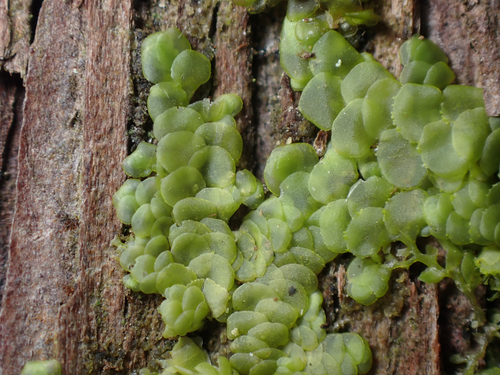
Radula complanata is a small leafy liverwort in the family Radulaceae that grows in flat, closely pressed, rounded patches on tree bark, rock, and walls. The green to yellow-green shoots are about 0.04–0.08 inch (1–2 mm) wide and creep over the surface, with two rows of overlapping rounded leaves, each leaf carrying a small squarish lobule folded beneath it. The shoots branch freely and form neat, circular mats a few centimetres across. Pale green disc-shaped gemmae develop in clusters along the leaf margins and break off to start new plants, the main way the species spreads. Like all liverworts it is non-vascular and reproduces by spores as well as gemmae, with spore capsules raised on short, pale, translucent stalks when present. It grows on the bark of trees, especially in humid woodland and along watercourses, and also on shaded, lime-free rock. It needs steady humidity and clean air and thins out in dry, exposed, or polluted sites.
Native Range
Widely distributed across the temperate and boreal Northern Hemisphere, including Europe, northern Asia, and North America, with scattered occurrences elsewhere. It is common on trees in humid woodland through much of this range.Suggested Uses
Radula complanata has no horticultural use and is left in place as part of the natural epiphyte community on trees. In survey work it is recorded as an indicator of humid, clean-air woodland and stable, undisturbed bark.How to Identify
Appearance
Colors
Foliage Colors
Fall Foliage Colors
Bloom Information
As a liverwort, Radula complanata does not flower. It reproduces by spores released from short-lived capsules raised on pale translucent stalks, mainly in spring, and by disc-shaped gemmae shed from the leaf margins through the year. Gemmae are the more frequent means of spread.
Detailed Descriptions
Foliage Description
yellow-greenGrowing Conditions
Sun Requirements
Tolerates up to 4 hours of direct sunlight daily
• Full Sun: 6+ hours of direct sunlight
• Partial Shade: 3-6 hours of direct sunlight
• Full Shade: Less than 3 hours of direct sunlight
Water & Climate
Water Needs