Overview
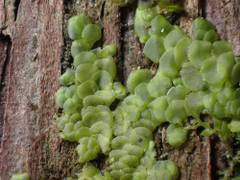
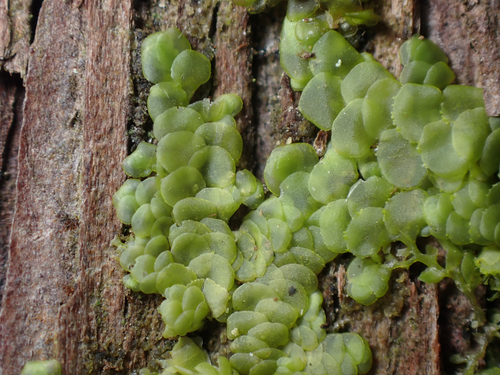
Radula is a large genus of leafy liverworts in the family Radulaceae, with roughly 200 species distributed worldwide. Plants form flat, closely appressed patches or thin mats of green to yellow-green or brownish shoots 0.4-3 inches (1-8 cm) long, the branches spreading in one plane against bark, rock, or living leaves. Leaves are arranged in two overlapping ranks, each divided into a larger rounded upper lobe and a much smaller lobe, the lobule, folded against the underside of the stem; underleaves are absent. Rhizoids arise from the lobules rather than directly from the stem, a feature that helps define the genus. Many species reproduce by disc-shaped gemmae shed from leaf margins as well as by spores released from short-lived capsules held in a flask-shaped perianth. Shoots are thin and somewhat translucent, drying to a darker film that swells and greens within minutes of wetting. Colonies enlarge slowly over years and persist on stable surfaces. Most species depend on steady humidity; shoots shrivel in dry air and revive when rewetted, and prolonged sun or drying ends a colony.
Native Range
Species of Radula occur on every continent except Antarctica, with the greatest diversity in moist tropical and oceanic temperate regions. Plants grow mainly as epiphytes on tree bark and leaves, and on shaded, humid rock, from coastal forest to montane cloud forest.Suggested Uses
Encountered as bark and rock epiphytes in woodland and forest, and occasionally kept in shaded terrariums and vivariums on wood or stone. Establishment depends on high humidity and shade, and colonies decline in dry or exposed positions.How to Identify
Appearance
Size & Dimensions
Width/Spread1" - 8"
Colors
Foliage Colors
Fall Foliage Colors
Detailed Descriptions
Foliage Description
green to yellow-green or brownishGrowing Conditions
Sun Requirements
Tolerates up to 3 hours of direct sunlight daily
• Full Sun: 6+ hours of direct sunlight
• Partial Shade: 3-6 hours of direct sunlight
• Full Shade: Less than 3 hours of direct sunlight
Water & Climate
Water Needs