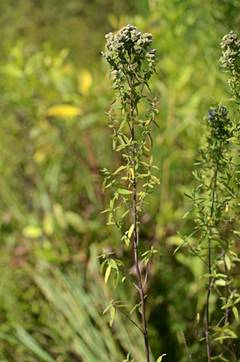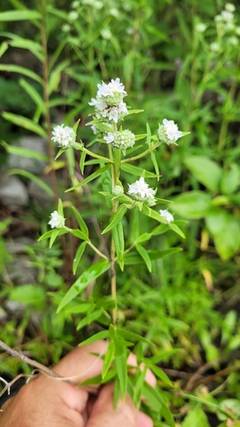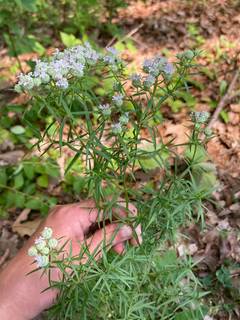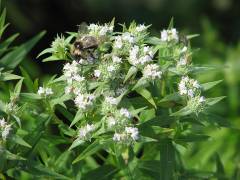
Pycnanthemum, Genus, muticum, Species,
- Genus & species
short-toothed mountain mint
Eastern North America (from Maine south to Florida and west to Michigan and Texas); meadows, woodland edges, and stream banks.
Overview
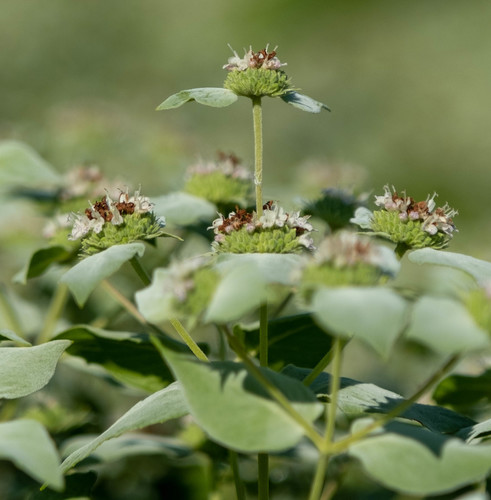
Pycnanthemum muticum is short-toothed mountain mint (clustered mountain mint), an upright native eastern North American perennial in the mint family (Lamiaceae) growing 24-36 inches (60-90 cm) tall and 24-36 inches (60-90 cm) wide as a clump that spreads by rhizomes (underground horizontal stems that emerge a short distance from the parent and produce new daughter shoots). Dense terminal flower clusters 0.5 inch (1.3 cm) across surrounded by silvery-white bracts (modified upper leaves with a powdery white coating) appear from July through September across an 8+ week display window — the silvery bracts are the species' principal visual feature and read at distance as a frosted or dusted appearance across the upper third of the plant, with the bracts visually dominating the tiny white-to-pale-lavender actual flowers that produce most of the pollinator nectar. The species is in the broader Lamiaceae mint family, sharing the square four-sided stem cross-section, the opposite leaf arrangement, and the strong essential-oil aromatic chemistry that the family carries as family-wide diagnostic characters with Mentha (mint), Salvia (sage), Nepeta (catmint), Lavandula (lavender), Thymus (thyme), and Origanum (oregano); the species' aromatic chemistry produces a strong mint scent when foliage is crushed or brushed, and the chemistry deters deer and rabbit browsing as it does across most of the aromatic Lamiaceae genera. The species is one of the more pollinator-rich native plants in the eastern North American flora — published pollinator research from Mt. Cuba Center and other native-plant research programs has documented 50 or more pollinator species (bees, wasps, butterflies, flies, beetles) visiting a single stand during the bloom period, placing the species at the top of native-pollinator-attractor recommendations for eastern North American gardens. The rhizomatous spread is the species' principal cultivation watchout: in moist fertile soil, the species can spread 12 or more inches per year and colonize a substantial area within 3-5 seasons of planting; containment strategies include vertical root barriers (8-10 inches deep), planting in lean dry soil that slows the spread, or growing in 7-gallon or larger containers that contain the rhizomes within the pot. The species tolerates a substantial range of soils including clay, and the species' moist-meadow native habitat means consistently moist conditions support the strongest growth and the heaviest flowering. Dried seed heads on standing stems supply granivorous-bird food across winter and add structural value to the dormant-season planting. Deer and rabbits avoid the foliage from the strong mint-family aromatic chemistry.
Native Range
Pycnanthemum muticum is native to eastern North America, with a continuous range from Maine and southern Quebec south through the eastern United States to Florida and west to Michigan, Illinois, and Texas. The species occurs in moist meadows, prairie remnants, woodland edges, stream banks, and pond margins across the native range, with the species' physiological preference for moist-to-average soil and full-sun-to-partial-shade exposure reflecting the meadow-and-woodland-edge native habitat. The species is a native component of the eastern deciduous forest meadow-margin and wet-mesic prairie plant communities and is grown in native-plant restoration projects, prairie-and-meadow plantings, and native pollinator gardens across the continental United States as a component of multi-species native-plant mixes.Suggested Uses
Used in native-plant gardens, dedicated pollinator gardens, prairie restoration plantings, naturalized meadow plantings, rain gardens, and pond-margin plantings, with the species' high pollinator-species count making it a recurring choice for plantings designed to support insect biodiversity. The silvery-bracted upper plant gives the species visual interest at distance during the 8-week display window and the species reads as a textural-color element in mixed plantings rather than as a pure-flowering element. The rhizomatous spread suits the species to large-scale meadow and prairie plantings where the colonizing growth is desirable; in cultivated borders, root barriers or container culture in 7-gallon (26 liter) or larger pots controls the spread. The species pairs with companion native pollinator-supporting perennials including Echinacea purpurea, Liatris spicata, Monarda fistulosa, Eutrochium maculatum (Joe-Pye weed), and warm-season ornamental grasses (Panicum virgatum, Schizachyrium scoparium) for a multi-species native pollinator garden.How to Identify
Appearance
Size & Dimensions
Height2' - 3'
Width/Spread2' - 3'
Bloom Information
Tiny white to pale lavender two-lipped tubular flowers open in dense terminal clusters 0.5 inch (1.3 cm) across surrounded by silvery-white bracts from July through September across an 8-week active flowering window, with the silvery bracts persisting for 8 or more weeks (longer than the actual flowers) and continuing the visual display past the active flowering window. The species is one of the more pollinator-rich native plants in the eastern North American flora, with published research documenting 50 or more pollinator species visiting a single stand during the bloom period; bees (bumblebees, sweat bees, leafcutter bees, mason bees), wasps (parasitoid wasps, paper wasps), butterflies (skippers, hairstreaks, fritillaries), flies (syrphid flies, bee flies), and beetles all work the small open flowers. The high pollinator diversity and the long bloom window make the species a high-impact native pollinator-garden component.
Detailed Descriptions
Flower Description
Tiny white to pale lavender two-lipped tubular flowers in dense terminal clusters 0.5 inch (1.3 cm) across, with the actual flowers being individually small and visually subordinate to the silvery-white bracts (modified upper leaves) that surround each cluster and persist for 8 or more weeks across the bloom and post-bloom periodFoliage Description
Medium green; opposite ovate to lance-shaped leaves with a strong mint scent when crushed; the upper leaves immediately surrounding the flower clusters develop a silvery-white powdery coating that gives the plant its principal visual feature — the silvery-bracted floral display reads at distance as a frosted or dusted appearance across the upper third of the plantGrowing Conditions
Sun Requirements
Requires 4-10 hours of direct sunlight daily
• Full Sun: 6+ hours of direct sunlight
• Partial Shade: 3-6 hours of direct sunlight
• Full Shade: Less than 3 hours of direct sunlight
Care & Maintenance
Care Guide
Plant in full sun to partial shade with 4-10 hours of direct light. Average to moist well-drained soil at pH 5.5-7.5 supports the species; clay soil is tolerated, and the species' wet-meadow native habitat reflects a moisture-preferring physiological character that distinguishes the species from drought-tolerant Lamiaceae genera like Lavandula and Santolina. Watering is during establishment and through extended summer drought, with the species being moderately drought-tolerant once the rhizome network develops. The rhizomatous spread is the principal cultivation management point: in moist fertile soil, the spread can reach 12 or more inches per year, and containment strategies (vertical root barriers 8-10 inches deep, lean-soil planting positions, or 7-gallon container culture) are needed to keep the species from colonizing a larger area than the gardener wants. All stems are cut to 3-4 inches (7-10 cm) above ground level in early spring (March) before new growth emerges from the rhizome network; the dried seed heads and standing stems are left through fall and winter for granivorous-bird forage and structural interest. No deadheading is needed because the silvery-white bracts persist on their own through the post-flowering window and continue the visual display.Pruning
All stems are cut to 3-4 inches (7-10 cm) above ground level in early spring (March) before new growth emerges from the rhizome network. Dried seed heads and standing stems are left through fall and winter for granivorous-bird food and structural interest. No deadheading is needed because the silvery-white bracts persist on their own through the post-flowering window and the bracts give the species its post-bloom visual continuation.Pruning Schedule
Prune: March
early spring
Container Growing
Suitable for container growing
Minimum container size: 7 gallons