Psidium, Genus, spp., Multiple species,
- Genus
- Multiple species
guavas
Tropical America (Mexico, Caribbean, Central and South America)
Overview
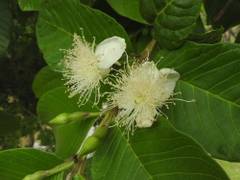
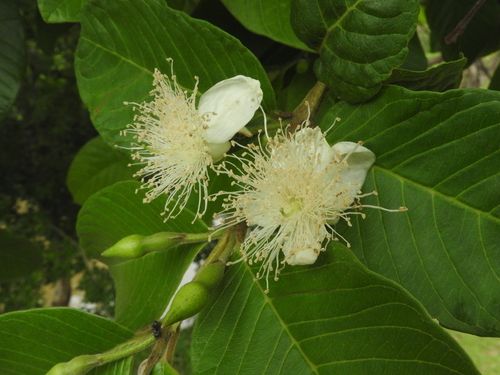
Psidium is a genus of about 100 evergreen shrubs and small trees in the myrtle family Myrtaceae, native to tropical and subtropical America. Plants grow 6 to 40 ft (1.8 to 12 m) tall, with smooth bark that flakes away in patches to leave a mottled, sinewy trunk, and opposite, leathery leaves with prominent veins. The flowers are white, 1 to 1.5 in (2.5 to 4 cm) across, with five petals and a brush of many white stamens, and are followed by rounded berries crowned by the dried sepals. P. guajava, the common guava, bears yellow-skinned fruit with pink or white pulp eaten fresh and made into juice and paste, while P. cattleyanum, the strawberry guava, carries smaller red or yellow fruit. Birds and mammals eat the fruit and scatter the seeds, and both species have become serious invaders of tropical forests in Hawaii, the Pacific, and elsewhere. Limitations include frost sensitivity, the invasive spread of seedlings, and shallow roots that make tall plants prone to wind-throw.
Native Range
Psidium is native to the lowland and montane tropics of the Americas, from Mexico and the Caribbean through Central America to Brazil, Paraguay, and northern Argentina. Plants grow in forest clearings, scrub, and disturbed ground. Through cultivation for their fruit, P. guajava and P. cattleyanum have spread and naturalized across the world's warm regions, where several now rank as aggressive weeds.Suggested Uses
Psidium is grown as a fruit tree in tropical and subtropical orchards and gardens, and dwarf forms are kept in containers for patios and greenhouses. The dense, twiggy growth is also used for informal screening in frost-free areas. Where it is not invasive, the fruit supports birds and other wildlife.How to Identify
Appearance
Size & Dimensions
Height6' - 40'
Width/Spread6' - 25'
Bloom Information
Psidium flowers through the warm season, mainly in spring and summer in subtropical climates and over much of the year near the equator. The white, many-stamened flowers open over several weeks and are worked by bees. Fruit ripens one to several months after flowering.
Detailed Descriptions
Foliage Description
green to dark greenGrowing Conditions
Sun Requirements
Requires 6-10 hours of direct sunlight daily
• Full Sun: 6+ hours of direct sunlight
• Partial Shade: 3-6 hours of direct sunlight
• Full Shade: Less than 3 hours of direct sunlight
Care & Maintenance
Care Guide
Psidium grows in full sun to light shade in moist, free-draining soil over a wide pH range from about 5.0 to 7.0, and tolerates poor and sandy ground. Established plants are moderately drought tolerant but fruit more heavily with steady moisture and feeding through the growing season. The genus is frost tender, with most species damaged below 28 to 30 F (-2 to -1 C), and grows as a tropical to warm-subtropical plant or in containers that can be sheltered. Because seedlings spread readily through bird-dropped seed, fallen fruit is cleared where the plants are not wanted. Plants resprout strongly from the base after frost or hard cutting.Pruning
Psidium is pruned after harvest to open the canopy, remove crossing branches, and hold trees at a pickable height. The genus fruits on new growth, so cutting back stems encourages fresh fruiting wood. Suckers and water sprouts from the base are removed through the season.Container Growing
Suitable for container growing