Psidium, Genus, guajava, Species,
- Genus & species
white guava
Mexico, Central America, Caribbean, South America
Overview
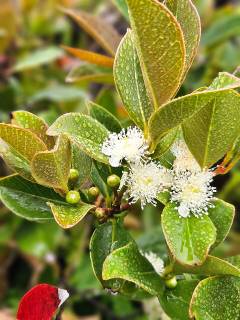
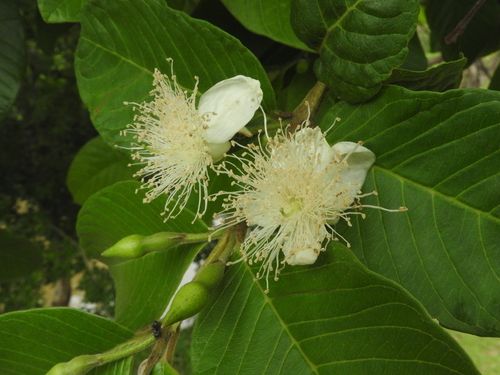
Psidium guajava is a small evergreen tree reaching 10-30 feet (3-9 m) tall and 10-25 feet (3-7.5 m) wide, with multiple trunks 4-12 inches (10-30 cm) in diameter. Bark thin, smooth, mottled in shades of green, copper, and grey, peeling in irregular plates to reveal younger pinkish bark beneath. Foliage simple, opposite, oblong-elliptic, 3-6 inches (7.5-15 cm) long with prominent parallel veins; leaves mid-green above, lighter beneath, pubescent on undersides when young. White flowers with 4-5 petals 0.6-1 inch (1.5-2.5 cm) across borne singly or in clusters of 2-3 on new wood; a conspicuous tuft of 200-300 white stamens forms the central mass. Fruit a many-seeded berry 1-4 inches (2.5-10 cm) in diameter, round to pear-shaped, ripening from green to yellow with white flesh in this cultivar group; flesh contains 50-200 hard seeds 0.1 inch (3 mm) across. Mature trees produce 100-300 fruits per season, ripening over 6-10 weeks. Cold damage occurs at 28°F (-2°C); leaves drop but trees regrow from roots after exposure to 20-25°F (-7 to -4°C) for short periods. Naturalized invasively in Hawaii, Florida, and many tropical island ecosystems where seed spread by birds expands populations rapidly.
Native Range
P. guajava is native to Mexico, Central America, the Caribbean, and northern South America, growing in tropical lowland forests, savanna edges, and disturbed areas at 0-5,000 feet (0-1,500 m) elevation. Cultivated worldwide in tropical and subtropical zones, with major commercial production in Mexico, India, Pakistan, Egypt, and Brazil. Listed as invasive in Florida (FLEPPC Category I), Hawaii, and many Pacific island nations.Suggested Uses
Grown as a fruit tree at 12-20 foot (3.7-6 m) spacing in tropical home orchards. Container culture is workable in pots of 15-25 gallons (57-95 L) with annual root pruning; container trees stay at 5-7 feet (1.5-2.1 m) and yield 20-50 fruits per year. Used in property-line hedges at 5-7 feet (1.5-2.1 m) tall in zones 9b-11. P. guajava is restricted from new plantings near native ecosystems in Hawaii, Florida, and Pacific islands under state and territorial nursery regulations due to invasive seed spread.How to Identify
Appearance
Size & Dimensions
Height10' - 30'
Width/Spread10' - 25'
Bloom Information
Multiple flushes per year in tropical climates, with 2-3 main flushes synchronized to rainfall and temperature peaks. In subtropical Florida and Mexico, flowering peaks April through June with secondary flushes in October. Individual flowers last only 1-2 days; the total flower-to-fruit cycle takes 16-24 weeks. Trees may flower year-round in equatorial climates with no defined dry season.
Detailed Descriptions
Flower Description
White with prominent stamen tuftFoliage Description
Mid-green above, lighter beneath; pubescent when youngGrowing Conditions
Sun Requirements
Requires 6-12 hours of direct sunlight daily
• Full Sun: 6+ hours of direct sunlight
• Partial Shade: 3-6 hours of direct sunlight
• Full Shade: Less than 3 hours of direct sunlight
Care & Maintenance
Care Guide
Water deeply once weekly during the establishment period (years 1-2) at 5-10 gallons (19-38 L) per application; established trees tolerate 4-6 weeks of drought but fruit yield drops by 30-50%. Apply a balanced citrus or fruit-tree fertilizer (8-3-9 or similar) at 1 pound (450 g) per inch of trunk diameter, divided into 3-4 applications between February and August. Caribbean fruit fly and oriental fruit fly oviposit in ripening fruit in tropical regions; bagging fruit at 1 inch (2.5 cm) diameter prevents infestation. Anthracnose causes leaf spots and fruit lesions during humid weather; copper fungicide reduces severity. Mulch 3-4 inches (7.5-10 cm) deep with composted material around the root zone, with a 6 inch (15 cm) clearance from the trunk. Lifespan 30-40 years in cultivation.Pruning
Prune in late winter while dormant in subtropical regions, or after fruit harvest in tropical regions. Retain 3-5 main scaffold branches and remove water sprouts and crossing limbs annually. Tip-prune lateral shoots to 4-6 buds during the growing season to encourage flowering on new wood. Heading cuts on mature branches stimulate dense regrowth from latent buds; renovation pruning to 4-5 foot (1.2-1.5 m) stub heights regenerates declining trees within 1-2 seasons.Pruning Schedule
Prune: February–March
winterearly spring
Container Growing
Suitable for container growing
Minimum container size: 15 gallons