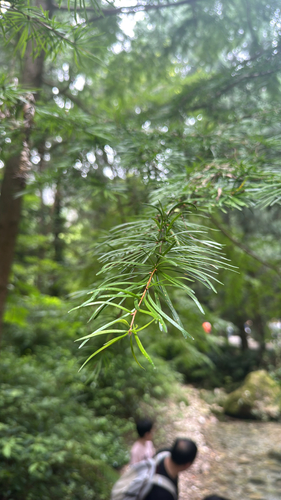
Pseudolarix, Genus, amabilis, Species,
- Genus & species
golden larch
Overview
Pseudolarix is a genus of deciduous conifers in the pine family (Pinaceae) containing the single species Pseudolarix amabilis, native to eastern China. In cultivation it forms a broadly conical to spreading tree 30-50 feet (9-15 m) tall and 20-40 feet (6-12 m) wide, reaching 100-130 feet (30-40 m) in its native forests over many decades. Growth is slow, often under 12 inches (30 cm) per year. The soft needles are 1.5-2.5 inches (4-6 cm) long, borne singly on long shoots and in dense whorls of 15-30 on short woody spurs, light green through summer and turning gold to orange-yellow before dropping in autumn. The bark is reddish-brown and furrowed into scaly ridges with age. Female cones 2-3 inches (5-7 cm) long stand upright on the branches, green ripening to yellow-brown, and break apart on the tree to release winged seeds. Branches are held nearly horizontal, forming a layered, open crown. The tree is slow to establish and intolerant of dry, alkaline, or compacted soils, growing poorly in cold-exposed or windy sites where late frosts damage emerging needles.
Native Range
Native to a small area of eastern China, in the mountains of Zhejiang, Jiangsu, Fujian, Jiangxi, Hunan, and Sichuan provinces. It grows in mixed mountain forests on acidic, well-drained soils at 1,500-4,000 feet (450-1,200 m), where it is now uncommon in the wild.Suggested Uses
Grown as a specimen tree in large lawns, parks, and woodland gardens where its autumn color and layered form have room to develop, set well clear of other trees. It needs space for a spread of 20-40 feet (6-12 m) at maturity and acidic, moisture-retentive soil. Young plants are sometimes trained as bonsai.How to Identify
Appearance
Size & Dimensions
Height30' - 50'
Width/Spread20' - 40'
Bloom Information
As a conifer, Pseudolarix bears pollen and seed cones rather than flowers. Pollen cones cluster on the spurs and shed pollen in mid-spring, around April. Green seed cones stand upright through summer and ripen to yellow-brown by autumn, then break apart on the branch to release the seeds.
Detailed Descriptions
Foliage Description
light green, turning gold in autumnGrowing Conditions
Sun Requirements
Requires 6-10 hours of direct sunlight daily
• Full Sun: 6+ hours of direct sunlight
• Partial Shade: 3-6 hours of direct sunlight
• Full Shade: Less than 3 hours of direct sunlight
Care & Maintenance
Care Guide
Grows in full sun in deep, moist, acidic, well-drained soil with a pH from 5.0 to 6.5; it fails on shallow, dry, or chalky ground. Steady moisture through the first several years supports establishment, after which it tolerates brief dry spells but not prolonged drought. The species needs shelter from strong wind and late spring frosts, which scorch the newly flushing needles. Growth is slow and feeding is seldom needed in reasonable soil. It has few serious pests or diseases, though root rot occurs in waterlogged ground. A mulch keeps the shallow roots cool and moist.Pruning
Little pruning is needed beyond removing dead, damaged, or crossing branches in late winter while dormant. The naturally layered branch structure develops without training and is lost if the leader or main limbs are cut back. Lower branches can be left to the ground or raised gradually to reveal the trunk.Pruning Schedule
Prune: February
winter
