Pseudofumaria, Genus, lutea, Species,
- Genus & species
yellow fumitory
Southern Alps (northern Italy, southern Switzerland)
Overview
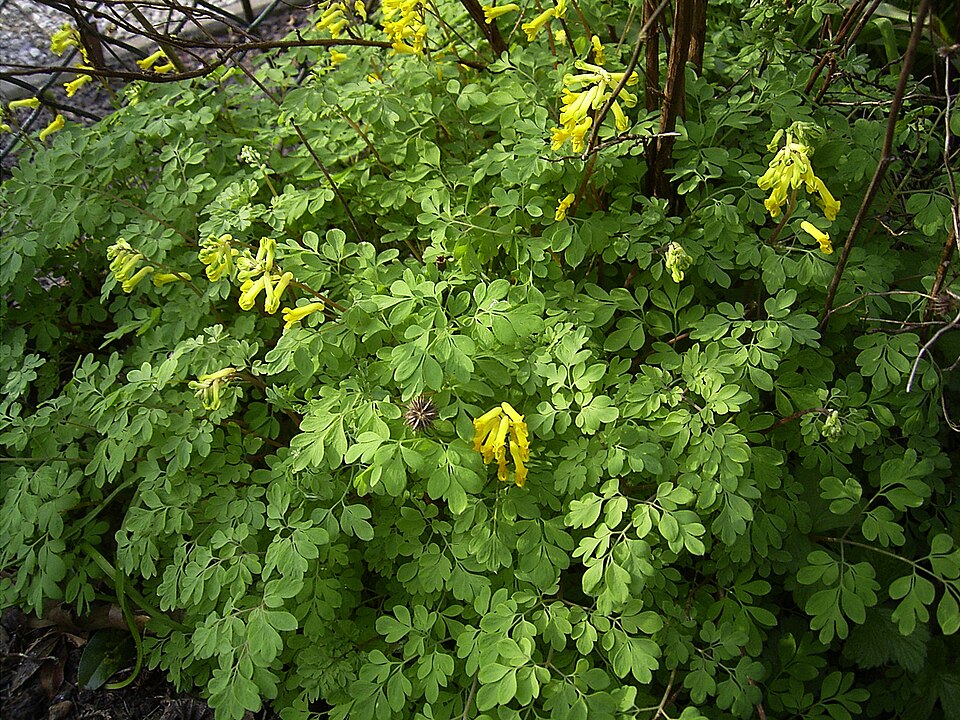
Pseudofumaria lutea, formerly classified as Corydalis lutea, is a clump-forming perennial in the poppy family (Papaveraceae) reaching 6-12 inches (15-30 cm) tall and 8-12 inches (20-30 cm) wide. The foliage is glaucous blue-green and finely divided into ternately compound, fern-like leaflets that form a low mound. From late spring into autumn it carries short racemes of tubular yellow flowers, each 0.5-0.8 inch (12-20 mm) long with a rounded spur, held just above the leaves. The plant roots into mortar joints, wall crevices, and rocky alkaline ground, where a taproot anchors it in shallow pockets of soil. It self-seeds prolifically, and seedlings appear in paving cracks and adjacent beds, which can require removal where spread is unwanted. Foliage stays green through mild winters and dies back in hard frost. Native to the southern Alps, it has naturalized across much of Europe, the British Isles, and parts of North America. Stems and roots contain isoquinoline alkaloids. Growth is densest in cool, partly shaded positions with sharp drainage, and plants are shorter-lived in heavy, wet soil.
Native Range
Native to the southern Alps and their foothills in northern Italy and southern Switzerland, where it grows on limestone cliffs and rocky slopes. It has naturalized widely beyond this range, colonizing old walls and stonework across Britain, central and western Europe, and scattered parts of North America.Suggested Uses
Used in rock gardens, dry stone walls, gravel gardens, and shaded crevices where its mounded habit fills vertical and horizontal joints. Grown in containers and trough plantings with gritty, free-draining compost. Suited to cottage and informal border edges in cool climates.How to Identify
Appearance
Size & Dimensions
Height6" - 1'
Width/Spread8" - 1'
Colors
Bloom Information
Flowering begins in May and continues through October in cool, moist conditions, with the heaviest flush in early summer. Individual racemes are replaced over many weeks, so flowers and ripening seed capsules are often present together. In hot, dry summers flowering pauses and resumes as temperatures fall.
Detailed Descriptions
Foliage Description
glaucous blue-greenGrowing Conditions
Sun Requirements
Requires 2-5 hours of direct sunlight daily
• Full Sun: 6+ hours of direct sunlight
• Partial Shade: 3-6 hours of direct sunlight
• Full Shade: Less than 3 hours of direct sunlight
Care & Maintenance
Care Guide
Grow in partial shade to full shade with sharp drainage; established plants tolerate full sun where soil stays cool and moist. Alkaline to neutral soils suit it, including the lime-rich mortar of walls and rock crevices. Water occasionally during establishment, after which the taproot draws on stored moisture and routine irrigation is rarely needed. The plant needs no feeding and declines in rich, waterlogged ground. Self-sown seedlings can be lifted and transplanted while small, as the taproot transplants poorly once mature. In hard-winter regions the topgrowth dies back and regrows from the crown in spring.Pruning
No formal pruning is needed. Shear spent foliage and seed heads in late autumn or early spring to limit self-seeding and tidy the mound. Plants regenerate from the crown after cutting back.Container Growing
Suitable for container growing
Minimum container size: 1 gallons