Prosartes, Genus, hookeri, Species,
- Genus & species
Hooker's fairy bells
Western North America: Alaska to California, east to Black Hills
Overview
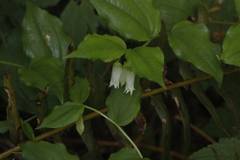
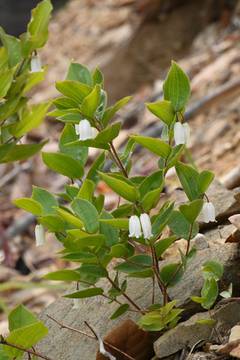
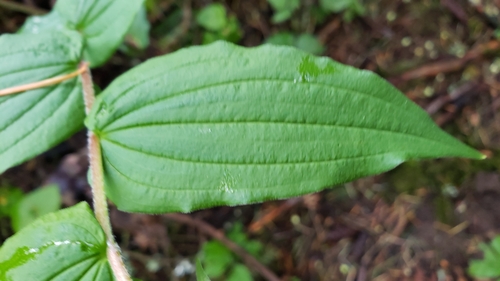
Prosartes hookeri is a herbaceous perennial reaching 12-30 inches (30-75 cm) tall and 12-18 inches (30-45 cm) wide, forming loose clumps from a slender creeping rhizome. Stems are erect to arching and branch in the upper third, bearing alternate lance-ovate to broadly ovate leaves 2-4 inches (5-10 cm) long with three to seven prominent parallel veins and a fringe of short hairs along the margins. Flowers are pendant bell-shaped tubes 0.4-0.7 inches (10-18 mm) long, creamy white to greenish-white, hanging singly or in pairs from the branch tips and partly hidden beneath the upper leaves. Bloom occurs from April through June. Flowers are followed by elongated apricot-orange to bright red berries 0.3-0.5 inches (8-13 mm) long that ripen in late summer. Foliage yellows with first frost and dies back by mid-October in most of the range. Plants spread slowly by short rhizomes, advancing 2-4 inches (5-10 cm) per year on suitable woodland soils. P. hookeri replaces P. smithii in drier interior forests and overlaps with it on the coast. Lower stems lodge in heavy rain on saturated soils, leaving prostrate growth that recovers the following spring.
Native Range
Native to western North America from southeastern Alaska south through British Columbia, Washington, Oregon, and northern California, east to Idaho, Montana, and the Black Hills of South Dakota. Found in moist coniferous and mixed forests, riparian woodlands, and shaded streamsides at 0-7,000 feet (0-2,100 m) elevation.Suggested Uses
Used in shaded woodland gardens, native plant collections, and stream-bank plantings west of the Cascades and in the northern Rockies. Spaced 12-18 inches (30-45 cm) apart in groupings of 5-7 plants for visible flowering effect, given the small partly-hidden flowers. Not adapted to sunny lawn-edge plantings or to the dry hot summers of zone 9 west desert sites.How to Identify
Appearance
Size & Dimensions
Height1' - 2'6"
Width/Spread1' - 1'6"
Bloom Information
April through June across most of the range; begins late March in coastal Oregon and California and extends into early July at higher elevations in the northern Rockies. Individual flowers last 5-7 days; total bloom period at the plant level lasts 3-4 weeks. Berries mature 8-10 weeks after flowering and ripen in August and September.
Detailed Descriptions
Flower Description
Creamy white to greenish-whiteFoliage Description
GreenGrowing Conditions
Sun Requirements
Requires 1-4 hours of direct sunlight daily
• Full Sun: 6+ hours of direct sunlight
• Partial Shade: 3-6 hours of direct sunlight
• Full Shade: Less than 3 hours of direct sunlight
Care & Maintenance
Care Guide
Establish under deciduous or open coniferous canopy with consistent leaf-litter mulch; full sun causes scorch and bleached foliage in zones 7-8. Maintain soil moisture during the first 2 years; established plants tolerate brief summer dry spells but go early dormant in extended drought, dropping leaves by August in dry years. Slugs feed on emerging spring shoots in coastal gardens; damage is cosmetic and does not affect long-term vigor. Crown rot develops in poorly drained or compacted soils. Plants do not respond to fertilizer; the species evolved on low-nutrient forest duff. Divide carefully in early spring as new shoots emerge; coarse handling damages the slender rhizomes and sets back recovery 2-3 years.Pruning
Remove yellowing stems at the base in late October or November after the foliage has died back. Cutting before frost interrupts nutrient translocation back to the rhizome and weakens the following season's growth. Berry-bearing stems can be removed earlier if the fruit is not desired.Pruning Schedule
Prune: October–November
fall
Container Growing
Suitable for container growing
Minimum container size: 2 gallons