Portulaca, Genus, oleracea, Species,
- Genus & species
purslane
Likely originating in India or the Middle East; the species has a cosmopolitan weedy distribution maintained for millennia through human agriculture and trade.
SunFull Sun
Overview
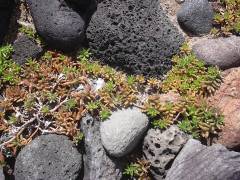
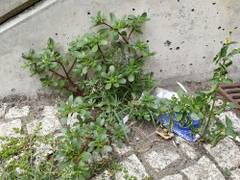
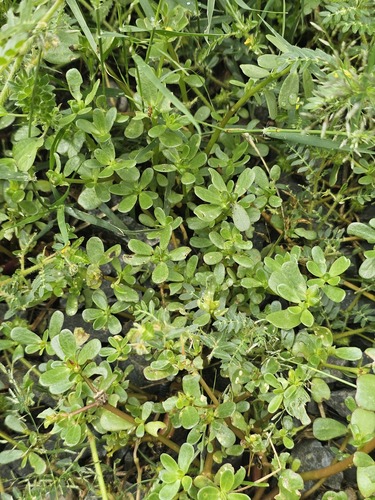
Portulaca oleracea is a prostrate succulent annual reaching 2-8 inches (5-20 cm) tall and 12-24 inches (30-60 cm) wide, forming spreading mats of thick fleshy succulent reddish-green stems and leaves. Leaves are dark green to reddish, obovate to spatulate, 0.5-1 inch (12-25 mm) long, smooth and glossy, carried on glossy reddish succulent stems. Five-petaled yellow flowers 0.2 inch (5 mm) across open only on sunny mornings for a few hours from June through September before closing for the rest of the day. Each flower produces a capsule containing thousands of tiny black seeds. The species uses C4 photosynthesis, a carbon-fixation pathway more common in tropical grasses than in succulents, and this dual adaptation accounts for competitive performance in hot dry conditions. Thick succulent stems reroot from fragments: each piece left on the soil surface can regenerate into a new plant, which means that removal from garden soil requires collecting all cut stem segments rather than leaving them in place. Plants tolerate a wide range of soil types, including alkaline soils up to pH 8.0 and compacted clay. The species is simultaneously cultivated worldwide as a leafy vegetable and managed as a weed in agriculture and horticulture, a dual status shared by only a handful of globally distributed plants. The entire plant, including leaves, stems, and flowers, is edible raw or cooked, and the leaves carry the highest alpha-linolenic acid (omega-3 fatty acid) content documented in any leafy vegetable.
Native Range
Portulaca oleracea likely originated in India or the Middle East, though the species has been cosmopolitan for so long that pinning down an exact origin is not possible from the historical record. Plants grow in disturbed ground, gardens, agricultural fields, and compacted surfaces in warm climates worldwide and have been cultivated as a leafy vegetable across Asia, the Middle East, the Mediterranean, and the Americas for thousands of years.Suggested Uses
Cultivated as an edible leafy vegetable and salad green, planted in vegetable beds, raised beds, and containers of 1 gallon (4 L) or more at 6 inch (15 cm) spacing after last frost. The leaves carry the highest alpha-linolenic acid (omega-3 fatty acid) content documented in any leafy vegetable, a nutritional profile that has drawn research attention in dietary and clinical nutrition literature. Plants tolerate heat, drought, and low-fertility soils that stress more conventional greens, which makes purslane a functional warm-season crop in Pacific Northwest sites where summer heat stresses lettuce and spinach. The same traits also make the species a common garden and agricultural weed, and both dimensions apply simultaneously in most garden settings.How to Identify
Appearance
Size & Dimensions
Height2" - 8"
Width/Spread1' - 2'
Bloom Information
Five-petaled yellow flowers 0.2 inch (5 mm) across open only on sunny mornings for a few hours from June through September, with a total bloom span of 10-12 weeks. Individual flowers last a few hours. Flowers are self-pollinating, and plants set seed even under cloudy conditions that restrict flower opening. Each capsule contains thousands of tiny black seeds that are released by a lid-like operculum and dispersed by water, foot traffic, and vehicle tires.
Detailed Descriptions
Flower Description
Yellow five-petaled flowers 0.2 inch (5 mm) across; open only on sunny mornings for a few hours before closingFoliage Description
Dark green to reddish; obovate to spatulate thick fleshy succulent leaves 0.5-1 inch (12-25 mm) long with a smooth glossy surface; held on glossy reddish succulent stemsGrowing Conditions
Sun Requirements
Requires 6-12 hours of direct sunlight daily
• Full Sun: 6+ hours of direct sunlight
• Partial Shade: 3-6 hours of direct sunlight
• Full Shade: Less than 3 hours of direct sunlight
Care & Maintenance
Care Guide
Plants grow in full sun in any well-drained soil with a pH of 5.5-8.0, including compacted clay and alkaline ground. Direct-sown seed germinates in 7-10 days at soil temperatures above 65°F (18°C), typically mid-May through June in Pacific Northwest lowlands. Leaves and stems are harvested on a cut-and-come-again schedule through the summer for culinary use. The succulent stems reroot from fragments as small as 0.4 inch (1 cm), so cut or pulled stems are removed from the soil surface to prevent regeneration. Plants are frost-sensitive and die at the first hard fall frost. No fertilization is required in most garden soils; the species tolerates low-nutrient and compacted ground that limits most leafy vegetables. In garden settings where the species is managed as a weed, deadheading before capsules mature reduces the extensive self-seeding.Pruning
Harvest succulent stems and leaves regularly through July and August on a cut-and-come-again schedule for culinary use. Remove seed capsules to reduce self-seeding. All cut or pulled stem material is collected from the soil surface because each fragment can root and regenerate. Plants die at first frost and are cleared at the end of the growing season.Pruning Schedule
Prune: July–August
summer
Container Growing
Suitable for container growing
Minimum container size: 1 gallons
Toxicity
Non-toxicPlanting Guide
Planting Methods & Timing
Planting Method
direct sow
Direct Sow Timing
Direct sow after the last frost date when soil temperatures hold above 65°F (18°C), typically mid-May through June in Pacific Northwest lowlands. Germination takes 7-10 days at soil temperatures of 65-75°F (18-24°C).
Days to Maturity
40–55 days
Plant Spacing
6 inches