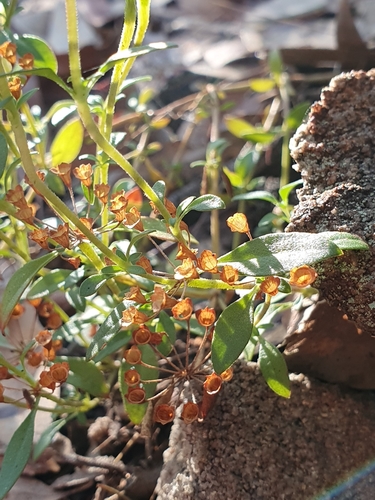
Pomax, Genus, umbellata, Species,
- Genus & species
pomax
Overview
Pomax umbellata is a small evergreen subshrub growing 0.2-0.6 m (8-24 in) tall and 0.2-0.5 m (8-20 in) wide, native to dry forest and heath across much of eastern and southern Australia. It forms a wiry, upright, sparsely branched plant from a woody base. The small opposite leaves are oval to elliptic, 0.5-2 cm (0.2-0.8 in) long, rough to the touch on both surfaces, and often paler beneath. In spring and summer the stems end in compact, umbel-like heads of small tubular cream-white flowers, each head cupped by a ring of leafy bracts that gives the plant its name. Tiny dry fruits follow, crowned by the persistent calyx. It grows on sandy and rocky low-nutrient soils in open, well-drained sites and tolerates frost and extended dry periods once established. The plant is inconspicuous outside flowering, with a thin, twiggy form, and is grown more for habitat and revegetation value than for show. It establishes slowly and dislikes rich, wet soils.
Native Range
Native to eastern and southern Australia, occurring in Queensland, New South Wales, Victoria, Tasmania, and South Australia, where it grows in dry sclerophyll forest, woodland, and heath on shallow sandy or rocky soils.Suggested Uses
Used in native, habitat, and revegetation plantings, low in rockeries, and among grasses and other small heath plants. Suits sandy, dry, low-maintenance gardens. Spaced 30-50 cm (12-20 in) apart in groups.How to Identify
Appearance
Size & Dimensions
Height8" - 2'
Width/Spread8" - 1'8"
Bloom Information
Detailed Descriptions
Foliage Description
greenGrowing Conditions
Sun Requirements
Requires 5-8 hours of direct sunlight daily
• Full Sun: 6+ hours of direct sunlight
• Partial Shade: 3-6 hours of direct sunlight
• Full Shade: Less than 3 hours of direct sunlight
Care & Maintenance
Care Guide
Grow in full sun to part shade on light, sharply drained sandy or rocky soil of low fertility. Water occasionally during establishment, then rely on rainfall, as the plant tolerates dry conditions and dislikes wet ground. High-phosphorus fertiliser is avoided; a light feed with low-phosphorus native blend is enough. Little pruning is needed beyond a light tidy. The species withstands frost and exposure. It establishes slowly and suits naturalistic and habitat plantings rather than formal beds.Pruning
A light trim after flowering keeps the wiry stems tidy and compact. The plant reshoots from the woody base if cut back lightly. Hard pruning into old bare wood is seldom needed and reshoots slowly.Pruning Schedule
Prune: December–January
summer
Container Growing
Suitable for container growing
Minimum container size: 3 gallons