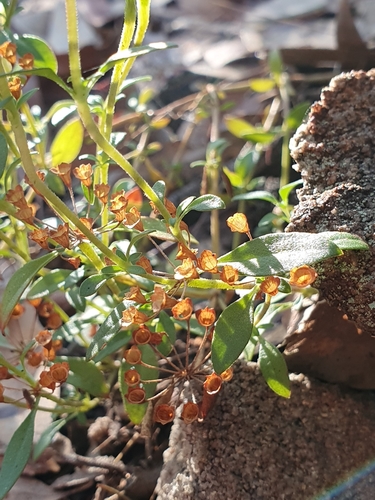
Pomax, Genus, spp., Multiple species,
- Genus
- Multiple species
pomax
Overview
Pomax is a small genus of low, wiry subshrubs in the madder family (Rubiaceae), native to Australia and represented chiefly by Pomax umbellata. Plants are much-branched and somewhat straggling, reaching 8-24 in (20-60 cm) tall, with rough, four-angled stems and small, stiff, rough-surfaced leaves set in opposite pairs or whorls. From spring into summer the branch tips carry compact, umbel-like heads of small tubular flowers, cream to white and sometimes tinged pink, surrounded by a collar of leafy bracts. The flowers ripen into small dry nut-like fruits enclosed in the persistent bracts. The genus grows in dry sclerophyll forest, woodland, and heath, usually on sandy or rocky, low-nutrient soils, and tolerates drought and seasonal fire. The rough foliage and small flowers make it more a plant of habitat and native gardens than of showy display. One limitation is its straggling, open habit, and another is the small size of the individual flowers.
Native Range
Pomax is native to eastern and southeastern Australia, including Queensland, New South Wales, Victoria, and South Australia. Plants grow in dry sclerophyll forest, heath, and rocky or sandy woodland, often on poor, well-drained soils.Suggested Uses
Grown in native, dry-climate, and rockery gardens, on sandy banks, and in habitat plantings for native bees and other small insects. The low, wiry growth suits informal ground among larger shrubs. Plants also stabilise light soils on dry slopes.How to Identify
Appearance
Size & Dimensions
Height8" - 2'
Width/Spread1' - 3'
Bloom Information
Flowering runs mainly from spring into summer, roughly September to January in the native range. The small cream to white tubular flowers open together in compact terminal heads. Bracts persist around the developing fruit after the flowers fade.
Detailed Descriptions
Flower Description
cream to whiteFoliage Description
greenGrowing Conditions
Sun Requirements
Requires 5-10 hours of direct sunlight daily
• Full Sun: 6+ hours of direct sunlight
• Partial Shade: 3-6 hours of direct sunlight
• Full Shade: Less than 3 hours of direct sunlight
Care & Maintenance
Care Guide
Pomax grows in full sun to light shade on sharply drained sandy or gravelly soils that are low in nutrients, at an acidic to neutral pH of about 5.0 to 7.0. Plants tolerate drought once established and need little or no supplementary water in temperate climates. Phosphorus-rich fertilisers are avoided, as with many Australian natives, and lean soil keeps growth compact. The genus suits frost-free to lightly frosted, warm temperate climates and corresponds to roughly USDA zones 9 to 10. Open air movement and free drainage reduce root and foliage problems. Plants are propagated from seed or cuttings, both of which can be slow.Pruning
A light trim after flowering reduces the straggling habit and encourages denser branching. Cutting is kept within the leafy growth, as old bare stems reshoot slowly. Spent flower heads can be left, since the bracts hold the small fruits.Pruning Schedule
Prune: January–February
summer
Container Growing
Suitable for container growing
Minimum container size: 2 gallons
