Polytaenia, Genus, texana, Species,
- Genus & species
Texas prairie parsley
Overview
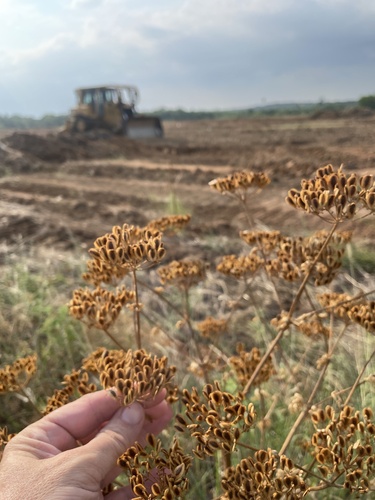
Polytaenia texana, Texas prairie parsley, is a biennial to short-lived perennial in the carrot family, growing 1.5-3 feet (45-90 cm) tall from a stout taproot. In the first year it forms a low rosette of deeply divided, parsley-like leaves; in the second year it sends up a branched, ridged flowering stalk. The leaves are 2-6 inches (5-15 cm) long, twice-divided into narrow, toothed segments. From spring into early summer the stems carry flat-topped compound umbels 2-4 inches (5-10 cm) across packed with tiny yellow flowers. The umbels ripen into flattened, winged seeds that aid wind dispersal. Native to the prairies and grasslands of Texas and the south-central United States, P. texana grows on open, sunny, well-drained limestone and clay soils in tallgrass and mixed prairie, fields, and roadsides. The foliage is a larval host for black swallowtail butterflies. One limitation is its short life: most plants flower once in the second year and then die, depending on seed to renew the stand. It tolerates drought and poor soil once the taproot is established.
Native Range
Polytaenia texana is native to the south-central United States, centred on Texas and reaching into Oklahoma, Kansas, and neighbouring states. It grows in tallgrass and mixed-grass prairie, open fields, and roadsides on well-drained limestone and clay soils.Suggested Uses
Polytaenia texana is grown in native prairie restorations, wildflower meadows, and butterfly gardens, where it serves as a host plant for black swallowtails. It suits sunny, well-drained borders and is sown in regional prairie seed mixes. Its spring umbels add early nectar before summer wildflowers open.How to Identify
Appearance
Size & Dimensions
Height1'6" - 3'
Width/Spread1' - 2'
Bloom Information
Flowering runs from March to May, peaking in spring of the second year. The flat yellow umbels draw bees, flies, and small beetles, and the foliage feeds black swallowtail caterpillars. Winged seeds ripen and shed by early summer.
Detailed Descriptions
Foliage Description
greenGrowing Conditions
Sun Requirements
Requires 6-10 hours of direct sunlight daily
• Full Sun: 6+ hours of direct sunlight
• Partial Shade: 3-6 hours of direct sunlight
• Full Shade: Less than 3 hours of direct sunlight
Care & Maintenance
Care Guide
Polytaenia texana grows in full sun on well-drained limestone, clay, or loam soils across a pH of about 6.5 to 8.0. As a biennial it is sown from seed in autumn, forms a rosette the first year, and flowers the second. It tolerates drought, heat, and poor, alkaline soil once the taproot forms and needs little water. The deep taproot makes transplanting difficult, so it is sown in place from seed. Plants self-sow where the ground stays open. Rich, wet soils and shade shorten their life.Pruning
P. texana needs no routine pruning. Spent flower stalks can be left to self-sow or cut once the seed has ripened. The first-year rosette needs no cutting back over winter.Toxicity
Non-toxicPlanting Guide
Planting Methods & Timing
Planting Method
direct sow
Plant Spacing
12 inches