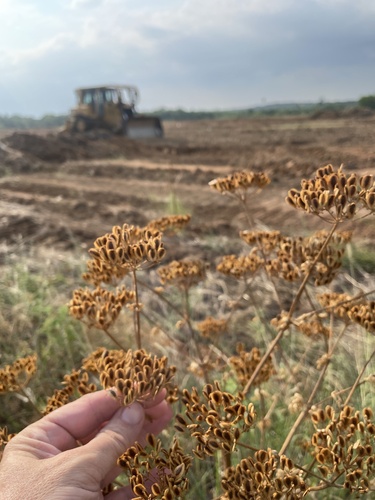
Polytaenia, Genus, spp., Multiple species,
- Genus
- Multiple species
prairie parsley
Overview
Polytaenia is a small genus of stout, taprooted herbs in the carrot family (Apiaceae), known as prairie parsley and native to the central and southern United States. Plants are biennials or short-lived perennials, forming a rosette in the first year and rising to 1.5-4 ft (45-120 cm) in flower. The leaves are firm, grey-green, and pinnately divided into broad, toothed segments, mostly clustered toward the base. In late spring and summer flat-topped compound umbels of small yellow flowers open at the stem tips, drawing many short-tongued insects. These ripen into flattened, broadly winged fruits that aid wind and water dispersal. The genus grows in tallgrass and mixed prairie, on limestone glades, and along open roadsides, surviving fire and drought through a deep taproot. Polytaenia nuttallii is the most widespread species. One limitation is the short individual life span, with many plants dying after flowering, and another is the coarse, open structure once the flower stems extend.
Native Range
Polytaenia is native to the central and southern United States, from the Great Lakes and the Great Plains south to Texas, with one species centred on Texas and adjacent areas. Plants grow in tallgrass and mixed prairie, limestone glades, open woodland, and roadside grassland.Suggested Uses
Grown in prairie restorations, native meadows, pollinator plantings, and rock or gravel gardens on alkaline soils. The yellow umbels support a broad range of native bees, wasps, and beetles. Plants suit dry, sunny banks where deep-rooted perennials are wanted.How to Identify
Appearance
Size & Dimensions
Height1'6" - 4'
Width/Spread1' - 2'
Bloom Information
Flowering occurs in late spring and early summer, roughly April to June depending on latitude. The yellow umbels open over a few weeks and attract a wide range of small pollinating insects. Winged fruits ripen by midsummer as the plant begins to senesce.
Detailed Descriptions
Foliage Description
grey-greenGrowing Conditions
Sun Requirements
Requires 6-12 hours of direct sunlight daily
• Full Sun: 6+ hours of direct sunlight
• Partial Shade: 3-6 hours of direct sunlight
• Full Shade: Less than 3 hours of direct sunlight
Care & Maintenance
Care Guide
Polytaenia grows in full sun on well-drained, often limy or rocky soils at a neutral to alkaline pH of about 6.5 to 8.0. Once established the deep taproot makes plants drought-tolerant, so watering is needed only for young seedlings. The genus withstands cold prairie winters in USDA zones 4 to 8 and resprouts or reseeds after fire. Seed germinates most reliably after a period of cold, moist stratification, and seedlings resent transplanting because of the taproot. Lean soils keep plants sturdy, while rich ground makes them tall and weak. Many plants die after setting seed, so a self-sowing colony maintains the planting.Pruning
No routine pruning is required. Spent flower stems are cut down after the winged fruits ripen, or left standing to self-sow and to feed seed-eating insects and birds. Rosettes are left undisturbed over winter.Pruning Schedule
Prune: July–August
summer
