Polygonum, Genus, aviculare, Species,
- Genus & species
common knotweed
Europe and western Asia; compacted paths, driveways, farmyards, roadsides, and waste ground from sea level to approximately 10,000 feet (3,000 m).
SunFull Sun
Overview
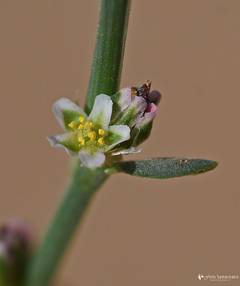
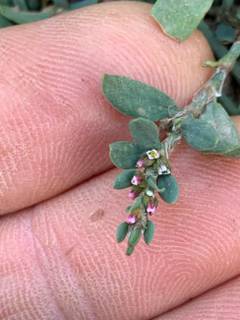
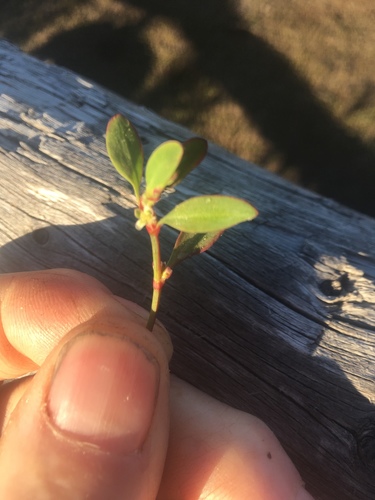
Polygonum aviculare is a prostrate wiry annual reaching 2-8 inches (5-20 cm) tall and 12-48 inches (30-120 cm) wide, forming flat mat-like colonies on compacted surfaces. Stems are prostrate, much-branched, wiry, tough, with swollen nodes and silvery papery tubular sheaths (ocreae) at each node, the Polygonaceae family-level identification feature. Leaves are alternate, elliptic to lance-shaped, 0.4-1.2 inches (10-30 mm) long, blue-green to gray-green, and progressively smaller toward the stem tips (heterophylly, a leaf-size gradient along the stem). Tiny greenish-white to pinkish flowers open singly or in clusters of 1-5 in the leaf axils, each with 5 tepals. Fruit is a dark brown trigonous (three-angled) achene 0.08-0.12 inch (2-3 mm) long with a dull (not shiny) surface. A single plant produces 500-6,000 seeds that remain viable in soil beyond 20 years. The species thrives on compacted heavily trafficked surfaces and is common on gravel driveways, sidewalk edges, field entrances, barn lots, and paths, a habitat preference shared with Matricaria discoidea (pineapple weed) and Plantago major as the three main soil-compaction indicator species of temperate paths.
Native Range
Polygonum aviculare is native to Europe and western Asia, where it grows on compacted paths, driveways, farmyards, roadsides, and waste ground from sea level to approximately 10,000 feet (3,000 m). The species has naturalized across all 50 U.S. states and all Canadian provinces and is a cosmopolitan weed of compacted high-traffic surfaces worldwide.Suggested Uses
The species is used in Polygonaceae identification courses for teaching ocrea structure and heterophylly (leaf-size variation along a stem). Dominance on a site is used as a soil-compaction indicator alongside Matricaria discoidea and Plantago major in land-management assessment. The long-lived soil seed bank, with viable seeds documented beyond 20 years, is a teaching example in weed seed biology. Seeds are consumed by ground-feeding birds and the species is studied in urban wildlife ecology; foliage has a long historical record of use as a famine food in several European and Asian cultures.How to Identify
Appearance
Size & Dimensions
Height2" - 8"
Width/Spread1' - 4'
Bloom Information
Tiny 5-tepaled greenish-white-to-pinkish flowers open continuously in the leaf axils as stems elongate from June through October, with a total bloom span of 10-14 weeks in the Pacific Northwest. Flowers are self-pollinating. Seeds mature progressively from the base of the stem outward toward the tips, and in the Pacific Northwest flowering runs from late spring through the first hard fall frost.
Detailed Descriptions
Flower Description
Greenish-white to pinkish; tiny flowers carried singly or in clusters of 1-5 in the leaf axils, with 5 tepals eachFoliage Description
Blue-green to gray-green; elliptic to lance-shaped, alternate, 0.4-1.2 inches (10-30 mm) long, progressively smaller toward the stem tips (heterophylly); each stem node carries a silvery papery tubular sheath (ocrea) that is the Polygonaceae family identification featureGrowing Conditions
Sun Requirements
Requires 6-12 hours of direct sunlight daily
• Full Sun: 6+ hours of direct sunlight
• Partial Shade: 3-6 hours of direct sunlight
• Full Shade: Less than 3 hours of direct sunlight