Image 1 of 10
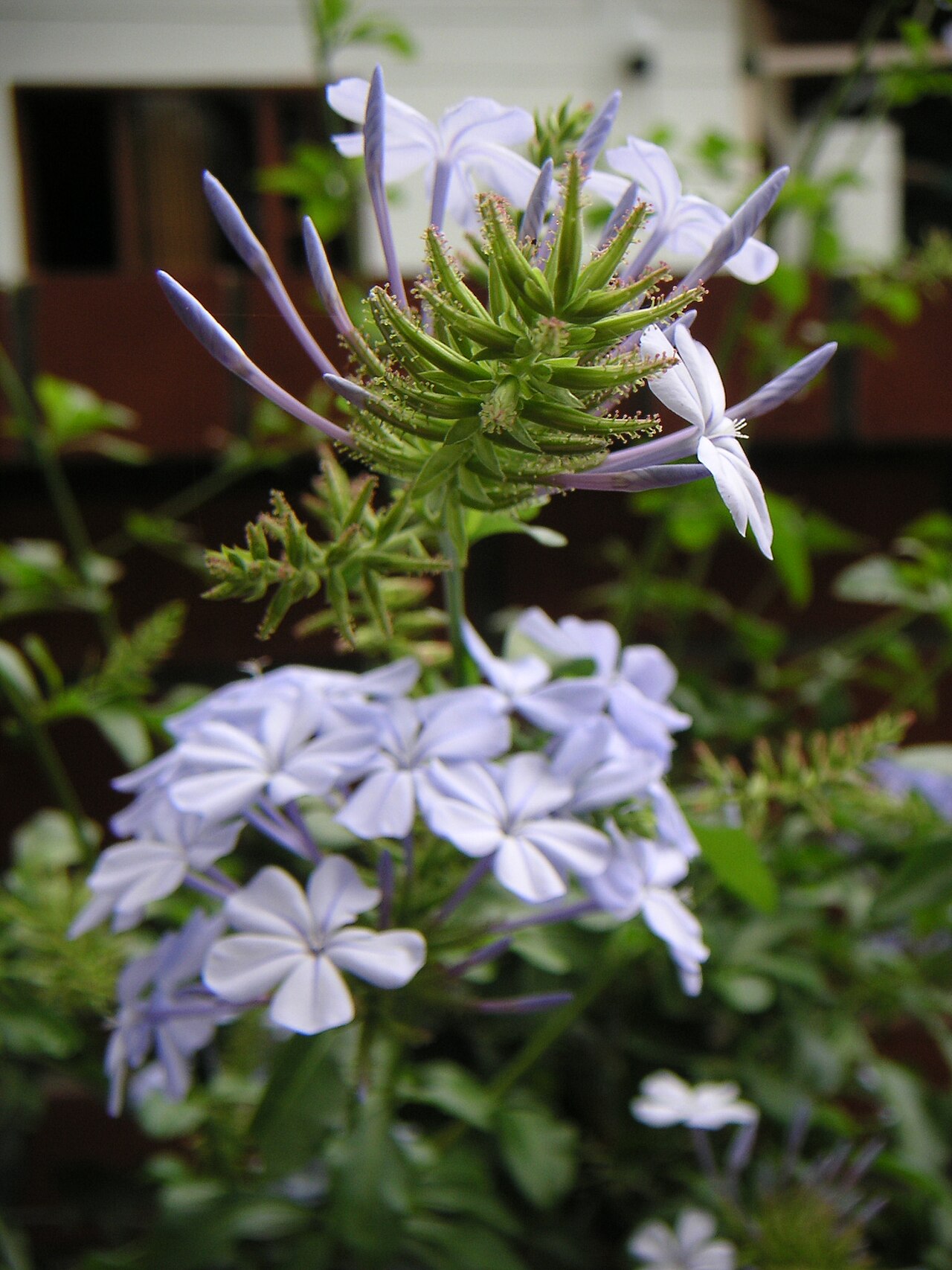
© Louise Wolff -- darina 00:04, 7 May 2005 (UTC), some rights reserved (CC-BY-SA) · Wikimedia Commons
1 / 10
Plumbago, Genus, auriculata, Species,
- Genus & species
Cape plumbago
Overview
Plumbago auriculata is an evergreen scrambling shrub reaching 3-10 feet (1-3 m) tall and 4-10 feet (1.2-3 m) wide, with thin arching stems that lean on neighboring plants and climb to 15 feet (4.5 m) when tied to a support. Leaves are alternate, spoon-shaped to oblong, 1-3 inches (2.5-7.5 cm) long and 0.4-1 inch (10-25 mm) wide, light green, with two small lobes clasping the stem at the leaf base. Flowers are pale sky blue, five-lobed and flat-faced, 0.8-1.2 inches (2-3 cm) across on a slender tube 1-1.5 inches (2.5-4 cm) long, gathered in heads of 15-30 at the shoot tips. The calyx is covered in sticky stalked glands that hold ripe seed onto clothing, fur, and feathers. Flowering runs from late spring through autumn in zones 9-11 and carries on year-round in frost-free coastal climates. Shoots extend 3-5 feet (0.9-1.5 m) in a season and flower on wood made the same year. Roots throw suckers 2-6 feet (60 cm-1.8 m) from the crown and build thickets over 3-5 years. All parts contain plumbagin, a naphthoquinone that reddens and blisters skin on repeated contact with the sap.
Native Range
Native to southern Africa, from the Eastern Cape and KwaZulu-Natal in South Africa north through Mpumalanga into Zimbabwe and Mozambique. Grows in bushveld, on rocky hillsides, and along forest margins from sea level to 5,900 feet (1,800 m), in summer-rainfall country receiving 20-40 inches (500-1,000 mm) per year. The species has naturalized in coastal eastern Australia, Hawaii, and parts of the Mediterranean.Suggested Uses
Planted at 4-6 foot (1.2-1.8 m) spacing as an informal hedge, bank cover, and fence-line screen in gardens across southern Africa, coastal Australia, southern California, Florida, and the Mediterranean. Grown in containers of 10 gallons (38 L) or larger and cut back each winter to hold plants at 3-4 feet (0.9-1.2 m). Root suckering and bird-carried seed have produced naturalized stands in coastal bushland in Queensland and New South Wales, where the species is recorded as an environmental weed.How to Identify
Appearance
Size & Dimensions
Height3' - 10'
Width/Spread4' - 10'
Colors
Bloom Information
Flowers open from late spring into autumn, May through October in USDA zones 9-11 of the Northern Hemisphere and November through April in southern Africa and eastern Australia. Flowering carries through winter in frost-free coastal gardens and stops where temperatures stay below 40F (4C). Each head holds 3-4 weeks as new flowers open behind those that have dropped. Flowers form on shoots of the current season, so plants cut back in late winter flower 8-10 weeks later.
Detailed Descriptions
Foliage Description
Light greenGrowing Conditions
Sun Requirements
Requires 6-12 hours of direct sunlight daily
• Full Sun: 6+ hours of direct sunlight
• Partial Shade: 3-6 hours of direct sunlight
• Full Shade: Less than 3 hours of direct sunlight
Care & Maintenance
Care Guide
Water weekly through the first summer, then every 2-3 weeks; established plants tolerate 6-8 weeks without water but carry 30-50 percent fewer flower heads. Soils from sand to clay at pH 5.5-8.0 are tolerated so long as water moves through, and growth slows in ground that stays wet through winter. Plants defoliate below 28F (-2C), die to ground level below 25F (-4C), and resprout from the root crown in spring where the soil does not freeze. Root suckers appear 2-6 feet (60 cm-1.8 m) from the crown and are cut below soil level or dug out with the root section attached; sap released at the cut reddens and blisters skin on repeated contact. Caterpillars of the cassius blue butterfly, Leptotes cassius, feed on the flower buds in Florida and along the Gulf Coast, leaving small holes in the calyx. Powdery mildew forms on shaded interior growth in humid summers and clears once the canopy is thinned.Pruning
Stems are cut back by one third to one half in late winter before growth starts, since flowers form on shoots made in the current season. Plants cut to 12-18 inches (30-45 cm) above ground level reshoot from the base and flower 8-10 weeks later. Left uncut for 3-4 years, plants build a mound of bare interior stems with flowering confined to the outer 12-18 inches (30-45 cm). Trimming spent heads through the season shortens the gap between flushes to 3-4 weeks.Pruning Schedule
Prune: February–March
winterearly spring
Container Growing
Suitable for container growing
Minimum container size: 10 gallons