Pluchea, Genus, odorata, Species,
- Genus & species
marsh fleabane
Coastal Americas (Atlantic and Gulf coasts to South America)
Overview
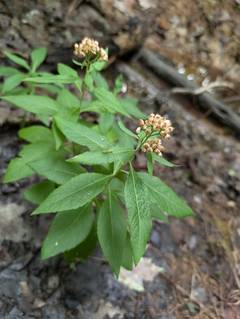
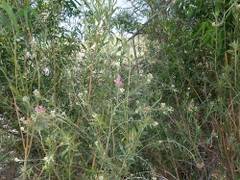
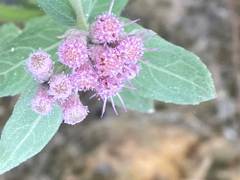
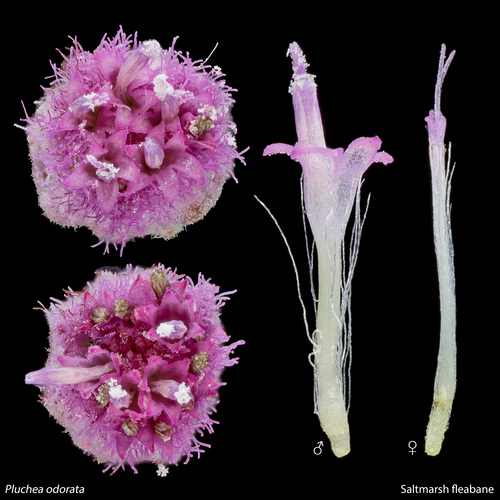
Pluchea odorata is an aromatic herb in the aster family, growing 1-4 feet (30-120 cm) tall with an upright, branched habit and a camphor-like scent released when the foliage is crushed. The alternate leaves are 2-5 inches (5-13 cm) long, lance- to egg-shaped, with toothed margins and a grayish-green, slightly downy surface. From midsummer into fall the stems are topped by flat to rounded clusters of small flower heads in shades of pink, rose, and purple; each head holds only disk florets and lacks the ray petals seen in many composites. The species grows in wet, often brackish habitats, including coastal salt marshes, freshwater marsh edges, ditches, and floodplains across the warmer Americas. It tolerates saline and alkaline soils that exclude many other herbs. Plants spread by seed and short rhizomes and can form colonies in suitable wet ground. The crushed foliage scent and pink flat-topped flower clusters make it recognizable in marsh settings. Limitations include intolerance of dry soil and frost, a tendency to spread in moist sites, and a short life in regions with cold winters, where it behaves as an annual. Bloom is followed by tiny dry seeds carried on a tuft of bristles.
Native Range
Pluchea odorata is native to the Americas, ranging along the Atlantic and Gulf coasts of the United States, through the Caribbean, Mexico, and Central America into South America. It grows in coastal salt marshes, brackish and freshwater wetlands, and moist disturbed ground.Suggested Uses
Grown in rain gardens, pond and marsh margins, and coastal plantings with moist or brackish soil. Used in wetland restoration and for stabilizing damp, saline ground. Suited to butterfly and pollinator gardens in warm, wet sites.How to Identify
Appearance
Size & Dimensions
Height1' - 4'
Width/Spread1' - 2'
Bloom Information
Flowering runs from midsummer into fall, generally July through October. The branched stems produce dense, flat to slightly rounded clusters of pink to purple flower heads that open over several weeks. Individual heads are small, about 0.25 inch (6 mm) across. Seeds with hairy bristles follow and disperse on the wind.
Detailed Descriptions
Flower Description
Pink to rose-purpleFoliage Description
Grayish-greenGrowing Conditions
Sun Requirements
Requires 6-12 hours of direct sunlight daily
• Full Sun: 6+ hours of direct sunlight
• Partial Shade: 3-6 hours of direct sunlight
• Full Shade: Less than 3 hours of direct sunlight
Care & Maintenance
Care Guide
Grows in full sun and consistently moist to wet soil, including brackish and saline ground that few garden plants tolerate. A soil pH of 6.0-8.0 suits the species, and it grows in clay, loam, or sand as long as moisture is steady. The plant does not tolerate drought and declines quickly in dry soil. In USDA zones 8-11 it can persist as a short-lived perennial; in colder regions it behaves as a frost-tender annual. No fertilizer is needed in the rich, moist soils where it grows. Plants can spread by seed and rhizome in damp settings, forming colonies over time.Pruning
Cut stems back after flowering to limit self-seeding in moist gardens. In frost-free areas, cut spent growth to the base in late winter to refresh the clump. No other pruning is needed.Pruning Schedule
Prune: February
winter