Pinguicula, Genus, vulgaris, Species,
- Genus & species
common butterwort
Northern hemisphere (Europe, Asia, North America)
Overview
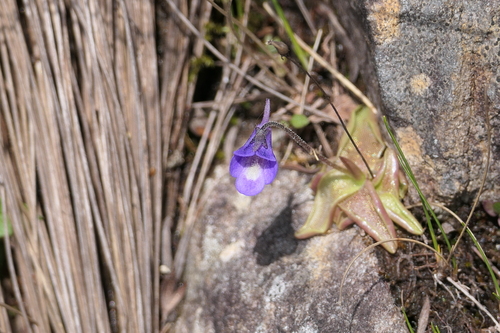
Pinguicula vulgaris is a small carnivorous perennial in the family Lentibulariaceae, forming a flat, ground-hugging rosette 1.2-6 inches (3-15 cm) across. The five to eight oblong, yellow-green leaves have inrolled edges and a greasy, sticky upper surface that traps small insects; glands then digest the prey and absorb nutrients, supplementing the poor soils where it grows. From May to July one to several leafless stalks 2-6 inches (5-15 cm) tall each carry a single violet to purple flower 0.4-0.6 inch (10-15 mm) across, two-lipped with a white throat and a backward-pointing spur. In autumn the rosette dies back to a compact winter resting bud that sits at the surface and produces detachable bulb-like offsets. The species grows in bogs, fens, wet heath, flushes, and on dripping rocks across northern and montane Europe, Asia, and North America, on permanently wet, nutrient-poor, often base-rich ground. It needs constant moisture, low fertility, and open conditions, and is quickly lost where richer plants close over or the ground dries out, which makes it hard to keep in cultivation.
Native Range
Native across the cooler parts of the northern hemisphere, including northern and mountainous Europe, northern Asia, and North America. It grows in bogs, fens, wet heaths, mountain flushes, and on wet, dripping rocks, on permanently moist, low-nutrient soils that are often base-rich.Suggested Uses
Grown in bog gardens, peat beds, and carnivorous-plant collections, and in shallow trays kept permanently wet with rainwater. Its sticky rosettes are sometimes used to catch fungus gnats and other small flying insects near plantings. It suits cool, wet, sunny corners rather than ordinary borders.How to Identify
Appearance
Size & Dimensions
Height2" - 6"
Width/Spread1" - 6"
Colors
Bloom Information
Flowering runs from May to July, each stalk bearing one violet to purple flower with a white-marked throat and a tapering spur. The flowers are pollinated by bees and other insects drawn to the spur nectar. After flowering, papery seed capsules split to release many tiny seeds.
Detailed Descriptions
Flower Description
violet to purpleFoliage Description
yellow-greenGrowing Conditions
Sun Requirements
Requires 4-10 hours of direct sunlight daily
• Full Sun: 6+ hours of direct sunlight
• Partial Shade: 3-6 hours of direct sunlight
• Full Shade: Less than 3 hours of direct sunlight
Care & Maintenance
Care Guide
Pinguicula vulgaris grows in full sun to light shade on permanently wet, low-nutrient ground such as bog gardens, peat beds, and the margins of acidic to slightly limy pools. It is watered only with rain or other mineral-free water, since tap water and fertiliser quickly kill it, and is grown in a lean mix of peat substitute and sand kept constantly damp. The sticky leaves catch their own insect food, so feeding is unnecessary and harmful. In autumn the plant shrinks to a winter resting bud that survives cold but rots in stagnant, overly rich conditions; small offset buds around it can be detached to make new plants. It needs open, uncrowded surroundings and is overtaken where mosses or larger plants grow over the rosette. Cool, bright, humid sites suit it.Container Growing
Suitable for container growing
Minimum container size: 1 gallons