Phyllospadix, Genus, torreyi, Species,
- Genus & species
Torrey's surfgrass
Northeastern Pacific coast (British Columbia to Baja California)
Overview
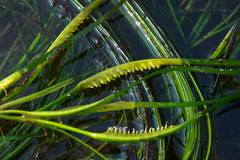
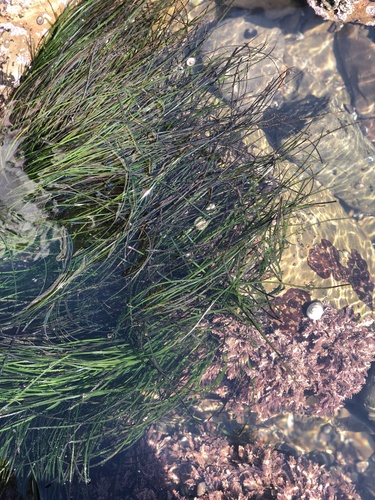
Phyllospadix torreyi is a marine flowering plant, one of the surfgrasses, that grows attached to rock in the surf zone of exposed Pacific coasts. It produces long, thread-like leaves 20-80 inches (50-200 cm) long and about 0.04-0.08 inch (1-2 mm) wide, bright green and flexible, streaming in the water with the wave surge. The plant anchors to rock by tough, wiry roots with stiff bristles that grip crevices, and spreads by branching rhizomes to form dense underwater meadows. It is dioecious, with separate male and female plants; tiny flowers are clustered on flattened structures hidden among the leaf bases and pollinated underwater by thread-like pollen carried in the current. After fertilization the female plants form curved, horned fruits that catch on the bristles of other surfgrass roots, which is how new plants establish. It grows from the low intertidal into shallow subtidal water on wave-swept rocky shores. Native to the northeastern Pacific, it forms habitat and shelter for fish, invertebrates, and the attached eggs of marine animals. It is a wild marine species and is not cultivated in gardens.
Native Range
Phyllospadix torreyi is native to the northeastern Pacific Ocean, ranging along the coast from southern British Columbia and Washington south through California to Baja California, Mexico. It grows on wave-exposed rocky shores from the low intertidal zone into shallow subtidal water.Suggested Uses
It is not used in horticulture and is not planted in gardens. Within its native range it is used in marine conservation and restoration for stabilizing rocky-shore habitat and sheltering fish and invertebrates. It also forms part of beach wrack that returns nutrients to shoreline food webs.How to Identify
Appearance
Size & Dimensions
Height1'8" - 6'8"
Width/Spread1' - 3'
Bloom Information
Flowering occurs mainly in winter and spring, with tiny flowers borne on flattened spadix-like structures concealed among the leaf bases. The plants are pollinated underwater by filamentous pollen drifting in the current. Curved, horned fruits ripen afterward and lodge on the roots of established plants.
Detailed Descriptions
Foliage Description
bright greenGrowing Conditions
Sun Requirements
Requires 6-12 hours of direct sunlight daily
• Full Sun: 6+ hours of direct sunlight
• Partial Shade: 3-6 hours of direct sunlight
• Full Shade: Less than 3 hours of direct sunlight
Water & Climate
Water Needs