Image 1 of 2
1 / 2
© Jerry Kirkhart from Los Osos, Calif., some rights reserved (CC-BY) · Wikimedia Commons
Phyllospadix, Genus, spp., Multiple species,
- Genus
- Multiple species
surfgrasses
North Pacific coasts (western North America and East Asia)
Overview
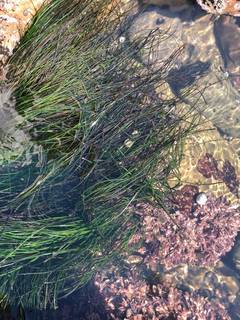
Phyllospadix is a genus of about five marine seagrasses in the family Zosteraceae, distributed along temperate rocky coastlines of the North Pacific from western North America to East Asia. Unlike most seagrasses, which root in soft sediment, Phyllospadix species attach directly to rock in the surf-swept intertidal and shallow subtidal zones using wiry rhizomes and stiff root hairs. The ribbon-shaped leaves are bright green, 0.04-0.16 inch (1-4 mm) wide, and reach 12-48 inches (30-120 cm) or more in length, arising in tufts from a creeping rhizome. Plants are dioecious, with separate male and female individuals; pollination happens underwater through thread-like pollen released into seawater. The genus forms dense submerged meadows that stabilize rocky substrate and shelter invertebrates, fish, and algae. Leaf length and meadow density vary with wave exposure and depth, and colonization is limited to hard surfaces in cool, well-oxygenated water. Established stands persist for many years through rhizome growth, though they are sensitive to sedimentation, warming water, and physical disturbance of the rocky shore.
Native Range
Temperate rocky coasts of the North Pacific Ocean. Species occur along the Pacific coast of North America from Alaska to Baja California and along the coasts of Japan, Korea, and the Russian Far East.Suggested Uses
Phyllospadix functions in coastal ecology as a habitat-forming species, creating underwater meadows that stabilize rocky substrate and shelter fish and invertebrates. It is studied in marine restoration and shoreline monitoring rather than grown in gardens.How to Identify
Appearance
Size & Dimensions
Height1' - 4'
Width/Spread1' - 3'
Bloom Information
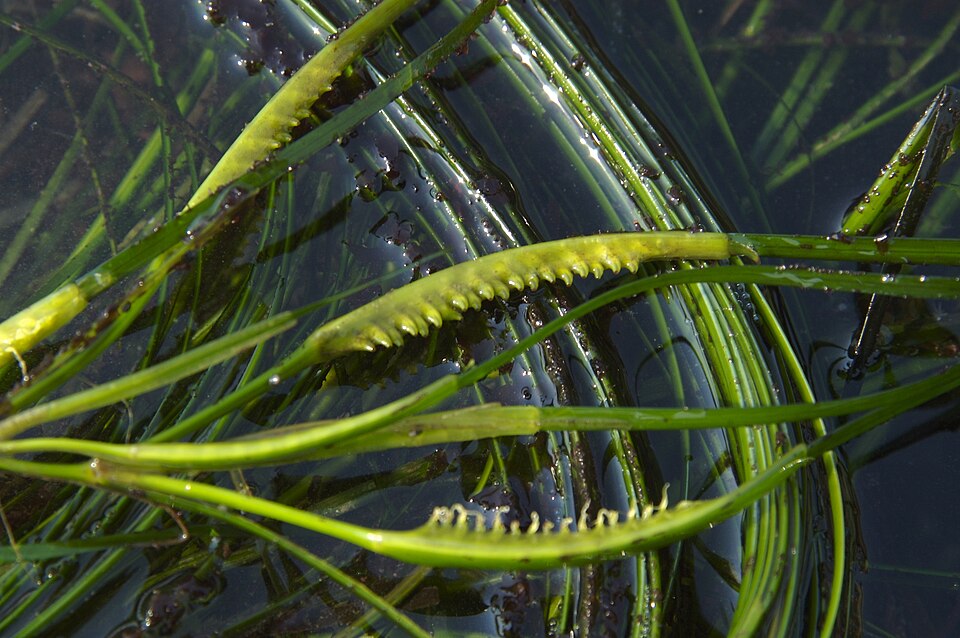
Flowering occurs underwater, mostly in spring and summer. Phyllospadix is dioecious; male plants release thread-like pollen into the water, and female plants bear inconspicuous flowers clustered at the leaf bases. Seeds develop with bristled bracts that catch on rock and algae, anchoring seedlings to hard surfaces.
Detailed Descriptions
Flower Description
Green, inconspicuousFoliage Description
Bright greenGrowing Conditions
Sun Requirements
Requires 6-12 hours of direct sunlight daily
• Full Sun: 6+ hours of direct sunlight
• Partial Shade: 3-6 hours of direct sunlight
• Full Shade: Less than 3 hours of direct sunlight
Water & Climate
Water Needs