Phyllanthus, Genus, calycinus, Species,
- Genus & species
false boronia
Overview
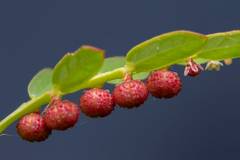
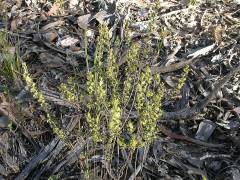
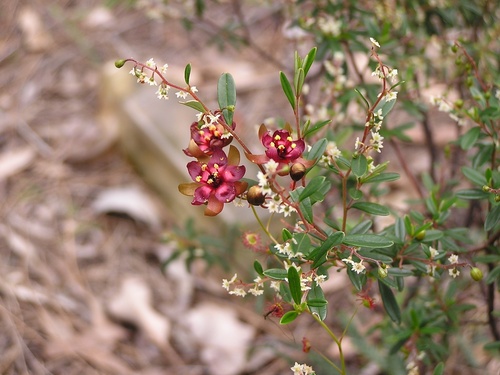
Phyllanthus calycinus is an erect to spreading shrub reaching 1-5 feet (0.3-1.5 m) tall and 1.5-3 feet (0.45-0.9 m) wide. Branches are slender and wiry, carrying small alternate leaves 0.2-0.6 inch (5-15 mm) long that are grey-green to blue-green and oval to elliptic. Flowers are borne singly or in small clusters in the leaf axils, each 0.2-0.3 inch (5-8 mm) across, with petal-like sepals that are reddish-maroon outside and cream to greenish inside; the plant is monoecious, carrying separate male and female flowers on the same branch. Flowering runs mainly from late winter through spring, July to November in the native range. The fruit is a three-lobed capsule about 0.1-0.2 inch (3-5 mm) wide that splits to release seed. The species grows in well-drained sandy and gravelly soils over laterite in open woodland and heath. It tolerates extended dry periods once established but is damaged by frost in climates colder than its native range. Small leaves and a slender twiggy habit give an outline resembling Boronia, the source of the common name False Boronia. Plants are relatively short-lived, persisting around 5-10 years in cultivation.
Native Range
Phyllanthus calycinus is endemic to the southwest of Western Australia, occurring from near Geraldton south to the Stirling Range and east toward Esperance. It grows in jarrah and wandoo woodland, kwongan heath, and around granite outcrops on sandy and gravelly soils.Suggested Uses
Planted in native and waterwise gardens, informal mixed shrub borders, and as low filler among larger shrubs. Suited to sandy coastal gardens and gravel beds with sharp drainage. Spaced 2-3 feet (0.6-0.9 m) apart in massed plantings.How to Identify
Appearance
Size & Dimensions
Height1' - 5'
Width/Spread1'6" - 3'
Colors
Bloom Information
Flowering runs from late winter into spring, roughly July to November in the native range. Male and female flowers are produced separately on the same plant on short axillary stalks. Sepal color is strongest on newly opened flowers and dulls with age.
Detailed Descriptions
Flower Description
Reddish-maroon with cream interiorFoliage Description
Grey-green to blue-greenGrowing Conditions
Sun Requirements
Requires 6-10 hours of direct sunlight daily
• Full Sun: 6+ hours of direct sunlight
• Partial Shade: 3-6 hours of direct sunlight
• Full Shade: Less than 3 hours of direct sunlight
Care & Maintenance
Care Guide
Phyllanthus calycinus grows in full sun to light shade in sharply drained sandy or gravelly soil. Established plants tolerate extended summer drought and need water only during prolonged dry spells in the first two seasons. The species is adapted to nutrient-poor soils and grows without added phosphorus; phosphorus-rich fertilizers can damage the roots, as in many southwest Australian natives. Cold hardiness extends only to frost-free or near-frost-free climates, roughly USDA zones 9-11. Plants persist about 5-10 years and are not long-term structural shrubs in a garden.Pruning
Light tip pruning after flowering keeps the shrub dense and removes spent flowering wood. Plants tolerate trimming of up to one-third of the current season growth but regrow slowly when cut into bare old wood. No routine pruning is needed beyond shaping.Pruning Schedule
Prune: November–December
late springsummer
Container Growing
Suitable for container growing
Minimum container size: 3 gallons