Phoradendron, Genus, californicum, Species,
- Genus & species
mesquite mistletoe
Sonoran and Mojave deserts of southwestern North America
Overview
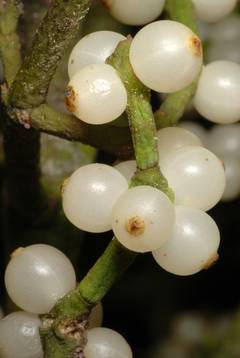
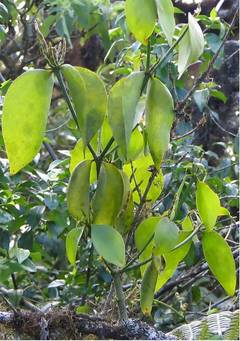
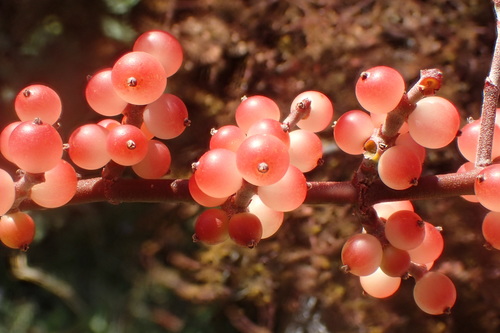
Phoradendron californicum is an aerial hemiparasitic shrub in the sandalwood family that grows on the branches of desert legume trees. It forms dense, pendent clusters of jointed, reddish-green to brownish stems 1-3 feet (30-90 cm) long, hanging from the host canopy. The plant is nearly leafless, its leaves reduced to tiny scales at the stem joints, so photosynthesis occurs in the green stems while water and minerals are drawn from the host through a modified root called a haustorium. Minute flowers, under 0.1 inch (2-3 mm), appear along the stems in winter and are followed by translucent pink to whitish berries about 0.2 inch (4-5 mm) wide. The sticky berries are eaten by birds, especially the phainopepla, which spreads the seeds to new host branches. P. californicum parasitizes mesquite, palo verde, acacia, and ironwood across the Sonoran and Mojave deserts, drawing enough resources that heavy infestations weaken or kill host limbs over time. The berries and stems contain toxic compounds and are not safe to eat. Growth is slow and tied entirely to the health of the host tree.
Native Range
Phoradendron californicum is native to the deserts of the southwestern United States and northwestern Mexico, including the Sonoran and Mojave deserts of California, Arizona, Nevada, Baja California, and Sonora. It occurs wherever its desert legume hosts grow.Suggested Uses
Phoradendron californicum is not planted ornamentally and is most often managed as a parasite of desert trees. It holds ecological value as a winter food source for birds and as a larval host for several hairstreak butterflies. Dried stems and berries are sometimes used in desert seasonal decorations.How to Identify
Appearance
Size & Dimensions
Height1' - 3'
Width/Spread1' - 3'
Bloom Information
Tiny inconspicuous flowers appear in winter, roughly December to March, along the green stems. Pollination is by small insects drawn to the stems. Berries ripen from late winter into spring and persist on the plant for weeks.
Detailed Descriptions
Foliage Description
reddish-greenGrowing Conditions
Sun Requirements
Requires 8-12 hours of direct sunlight daily
• Full Sun: 6+ hours of direct sunlight
• Partial Shade: 3-6 hours of direct sunlight
• Full Shade: Less than 3 hours of direct sunlight