Phoradendron, Genus, spp., Multiple species,
- Genus
- Multiple species
leafy mistletoes
Americas (United States to Argentina)
SunFull Sun
HardinessZones 7–11
Overview
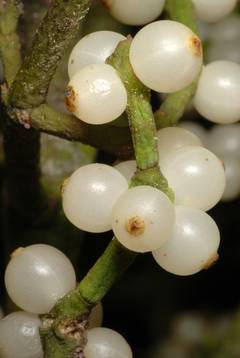
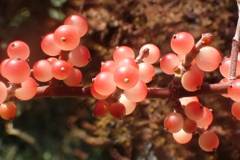
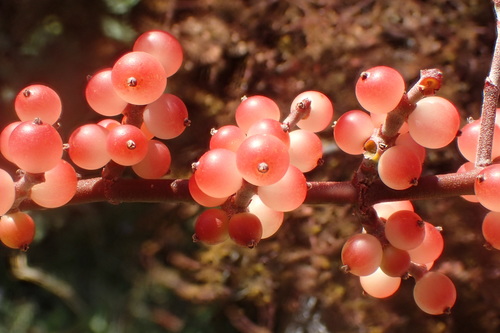
Phoradendron is a genus of about 230 evergreen, hemiparasitic shrubs in the family Santalaceae, distributed across the warmer regions of the Americas from the United States to Argentina. Plants attach to the branches of host trees and shrubs through modified roots called haustoria, drawing water and minerals while carrying out their own photosynthesis. Stems are jointed and brittle, branching repeatedly to form rounded clumps 1–3 ft (30–90 cm) across, occasionally larger on long-established hosts. Leaves are opposite, thick, and leathery, ranging from 0.4–2 in (1–5 cm) long depending on species; some species such as P. californicum are reduced to scales. Foliage colour spans yellow-green to olive-green and persists through winter. Small, greenish flowers are borne in short jointed spikes, followed by white, pink, or straw-coloured berries 0.1–0.2 in (3–5 mm) wide that birds eat and spread to new host branches. All parts contain phoratoxin and related lectins; ingestion can cause gastrointestinal upset in humans and animals. Because growth depends on a living host, Phoradendron cannot be cultivated as a free-standing garden plant, and heavy infestations reduce the vigour of host trees over time.
Native Range
Phoradendron occurs throughout the Americas, from the southern and western United States through Mexico, Central America, and the Caribbean into much of South America as far south as Argentina. The genus reaches its greatest diversity in Mexico and Central America, where it grows on a wide range of hardwood and conifer hosts.Suggested Uses
Phoradendron species are gathered in North America as seasonal greenery, the berried stems sold under the name mistletoe for winter decoration. In native habitats the plants feed birds and host the larvae of the great purple hairstreak butterfly. They are not cultivated as free-standing plants, since growth requires a living tree host.How to Identify
Appearance
Size & Dimensions
Height1' - 3'
Width/Spread1' - 3'
Colors
Bloom Information
Flowering occurs mainly from late summer through winter, varying by species and latitude. The greenish flowers are small and set in short jointed spikes. Berries ripen from autumn into winter, when they stand out against the bare canopies of deciduous hosts.
Detailed Descriptions
Foliage Description
yellow-green to olive-greenGrowing Conditions
Sun Requirements
Requires 6-12 hours of direct sunlight daily
• Full Sun: 6+ hours of direct sunlight
• Partial Shade: 3-6 hours of direct sunlight
• Full Shade: Less than 3 hours of direct sunlight