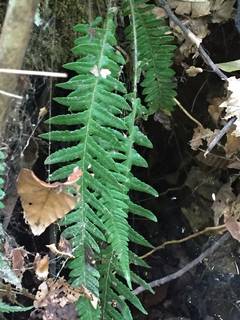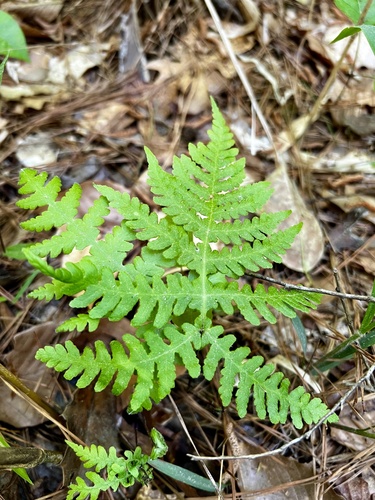
Phegopteris, Genus, hexagonoptera, Species,
- Genus & species
broad beech fern
Overview
Phegopteris hexagonoptera is a deciduous, colony-forming fern in the marsh-fern family, spreading by thin creeping rhizomes to form open patches of fronds 8-24 in (20-60 cm) tall. Each frond has a broadly triangular blade that is wider than long, cut into many pinnae that are themselves deeply lobed, with narrow green wings running along the central stalk and connecting the lowest pinnae. The lowest pair of pinnae angle forward and downward, giving the blade its characteristic outline. New fronds unfurl pale green in spring, mature to medium green, and yellow before dying back with autumn frost. Spore cases (sori) sit in small round dots near the margins on the frond undersides, without the papery covers found in many ferns. The fern grows in moist, shaded woodlands, ravines, and on rich wooded slopes across eastern North America. It spreads steadily where soil stays cool and damp and thins out in dry or sunny sites. The winged stalk and forward-pointing basal pinnae separate it from the northern beech fern Phegopteris connectilis, which has a narrower blade.
Native Range
Phegopteris hexagonoptera is native to eastern North America, ranging from Ontario and Quebec south to Florida and west to Texas and the eastern Great Plains. It grows in moist deciduous woodlands, shaded ravines, and on rich, wooded slopes.Suggested Uses
Phegopteris hexagonoptera is used as a ground-covering fern in shade gardens, woodland borders, and along the north side of buildings where soil stays moist. Its spreading habit fills cool, damp areas under trees and shrubs. It combines with wild ginger, foamflower, and other woodland natives.How to Identify
Appearance
Size & Dimensions
Height8" - 2'
Width/Spread1' - 2'
Bloom Information
As a fern, Phegopteris hexagonoptera produces no flowers. Spores ripen on the frond undersides from midsummer into autumn. Reproduction is by these wind-borne spores and by spreading rhizomes.
Detailed Descriptions
Foliage Description
greenGrowing Conditions
Sun Requirements
Tolerates up to 4 hours of direct sunlight daily
• Full Sun: 6+ hours of direct sunlight
• Partial Shade: 3-6 hours of direct sunlight
• Full Shade: Less than 3 hours of direct sunlight
Care & Maintenance
Care Guide
Phegopteris hexagonoptera grows in part to full shade on moist, humus-rich, slightly acidic soil and needs steady moisture through the growing season. It spreads by creeping rhizomes into open colonies and tolerates cold winters within USDA zones 3-8. Dry soil, direct sun, and drought cause the fronds to brown and the colony to thin. A mulch of leaf litter keeps the roots cool and damp and feeds the shallow rhizomes. The fronds die back fully each winter and return in spring. No staking or feeding beyond leaf mulch is needed.Pruning
Pruning is limited to removing the dead fronds in late winter or early spring before the new croziers unfurl. The fronds can be left in place over winter as natural mulch. No other cutting is required.Pruning Schedule
Prune: March
early spring