Persoonia, Genus, pinifolia, Species,
- Genus & species
pine-leaf geebung
Overview
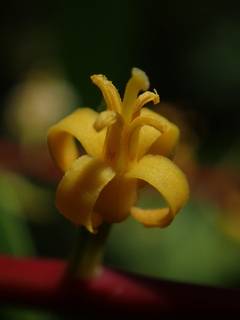
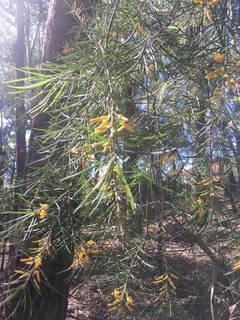
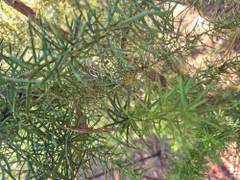
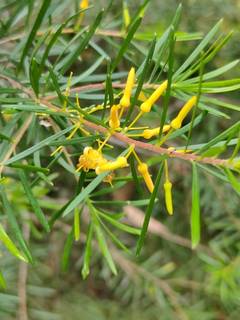
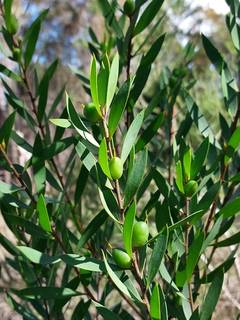
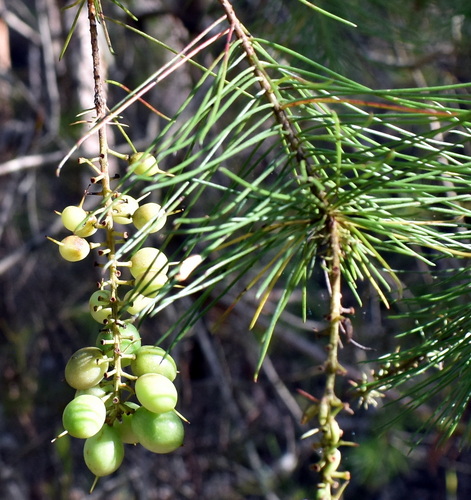
Persoonia pinifolia is an upright to arching shrub 6-10 feet (2-3 m) tall and 5-8 feet (1.5-2.5 m) wide, with soft, needle-like green leaves that resemble pine foliage. The leaves are 0.4-1.2 inches (1-3 cm) long and very narrow, crowded along the slender branches, which droop at the tips. Small tubular yellow flowers about 0.4 inch (10 mm) long open along pendulous spikes 4-8 inches (10-20 cm) long from late summer into autumn. The flowers are followed by fleshy green drupes about 0.4 inch (10 mm) long, clustered like small grapes and ripening through summer. Growth is moderate, and the arching branches give a soft, weeping outline. It grows in well-drained sandy soils over sandstone and is difficult to raise from seed, which has a deeply dormant, hard coat. Plants are sensitive to root disturbance and to poorly drained soils.
Native Range
Native to New South Wales, mainly the sandstone country around Sydney and the central coast. Grows in dry sclerophyll woodland and heath on well-drained, nutrient-poor sandy soils over sandstone.Suggested Uses
Grown as a screening and feature shrub in native and sandstone gardens, spaced 5-8 feet (1.5-2.4 m) apart, and in habitat plantings for its nectar and fruit. Suits well-drained, low-nutrient sites where many shrubs struggle. The weeping foliage and yellow flowers suit informal native borders.How to Identify
Appearance
Size & Dimensions
Height6' - 10'
Width/Spread5' - 8'
Bloom Information
Detailed Descriptions
Foliage Description
greenGrowing Conditions
Sun Requirements
Requires 5-10 hours of direct sunlight daily
• Full Sun: 6+ hours of direct sunlight
• Partial Shade: 3-6 hours of direct sunlight
• Full Shade: Less than 3 hours of direct sunlight
Care & Maintenance
Care Guide
Grows in full sun to light shade in sharply drained, sandy, nutrient-poor soil and resents heavy, wet, or limey ground. Water during dry spells in the first year to establish; mature plants tolerate drought once their roots reach depth. Phosphorus-rich fertilisers damage the roots, as with many Proteaceae. The plant is sensitive to root disturbance, so it is planted out small and left undisturbed. Frost-hardy to about 25°F (-4°C). Root rot in poorly drained soil is the main cause of plant loss, and seed is slow and difficult to germinate.Pruning
Light pruning after flowering keeps the shrub dense and maintains the weeping shape. Spent flower spikes and straggly stems are trimmed in autumn. The plant tolerates only light cutting and is slow to reshoot from old bare wood.Pruning Schedule
Prune: May–June
fall