Persoonia, Genus, levis, Species,
- Genus & species
broad-leaf geebung
Overview
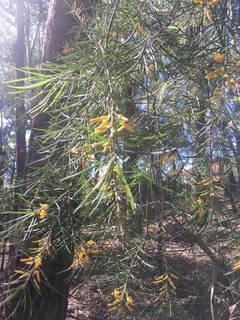
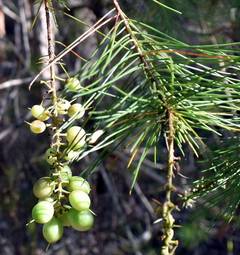
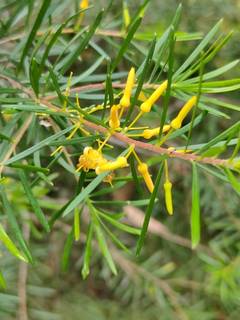
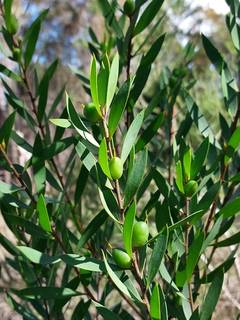
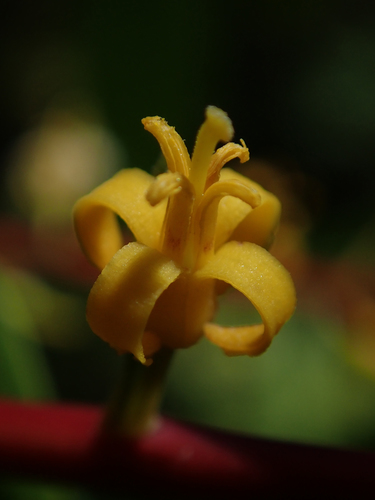
Persoonia levis is an evergreen shrub or small tree reaching 6-16 feet (2-5 m) tall with an open, spreading habit. The bark is dark grey and flaky on the outside, revealing a bright red to purplish underbark when the outer layer is shed. Leaves are large for the genus, sickle-shaped to broadly lance-shaped, 2-8 inches (5-20 cm) long and up to 1.5 inches (4 cm) wide, often slightly twisted, bright green, and smooth. Small yellow tubular flowers about 0.4 inch (10 mm) long appear singly along the stems in summer and autumn, each with four recurved tepals. The fruit is a fleshy green to purplish drupe about 0.4 inch (10 mm) long containing one or two seeds. Growth is moderate. Plants regenerate from a lignotuber after fire. The species needs sharply drained, sandy, acidic soils and is intolerant of phosphorus-rich fertilizers and heavy, wet ground.
Native Range
Native to southeastern Australia, in coastal and near-coastal New South Wales and eastern Victoria. Grows in dry sclerophyll forest and woodland on sandstone soils, often on ridges and slopes.Suggested Uses
Used in native and low-water gardens and in bushland restoration on sandy soils, spaced 5-8 feet (1.5-2.4 m) apart. The red underbark and broad foliage suit informal screening and habitat plantings. Exacting drainage and fertilizer needs limit its use in heavy or enriched soils.How to Identify
Appearance
Size & Dimensions
Height6' - 16'
Width/Spread5' - 13'
Bloom Information
Detailed Descriptions
Foliage Description
bright greenGrowing Conditions
Sun Requirements
Requires 5-9 hours of direct sunlight daily
• Full Sun: 6+ hours of direct sunlight
• Partial Shade: 3-6 hours of direct sunlight
• Full Shade: Less than 3 hours of direct sunlight
Care & Maintenance
Care Guide
Grows in full sun to part shade in sandy, acidic, sharply drained soils. Established plants tolerate dry periods and need watering only in extended drought. Phosphorus-rich fertilizers damage the roots, as with most plants in the protea family. Heavy, poorly drained soils cause root rot. Few pests affect it. Plants resprout from a lignotuber after fire or hard cutting.Pruning
Tolerates light to moderate pruning after flowering to maintain a compact shape. Plants resprout from the lignotuber if cut back hard. Tip pruning of young plants produces a denser, bushier form.Pruning Schedule
Prune: April–May
fall