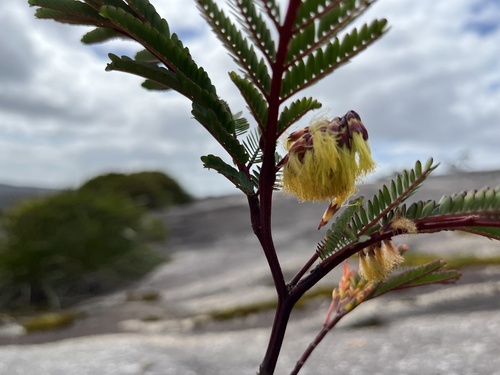
Paraserianthes, Genus, lophantha, Species,
- Genus & species
plume albizia
Overview
Paraserianthes lophantha is a fast-growing evergreen shrub or small tree reaching 10-30 feet (3-10 m) tall and 10-20 feet (3-6 m) wide, with a spreading crown and smooth grey-green bark. The foliage is bipinnate and fern-like, each leaf 4-8 inches (10-20 cm) long and divided into many small dark green leaflets. From late autumn to spring the plant carries cylindrical cream to greenish-yellow flower spikes 1.2-2.4 inches (3-6 cm) long, resembling pale bottlebrushes, followed by flat brown seed pods 2.4-4.7 inches (6-12 cm) long that release hard-coated seeds. As a legume it fixes atmospheric nitrogen through root nodules and grows quickly on poor soils. The species is short-lived, often declining after 10-15 years, and seeds prolifically. Paraserianthes lophantha is naturalised and treated as an environmental weed in South Africa, New Zealand, California, the Mediterranean, and parts of eastern Australia beyond its native range. It tolerates coastal exposure, drought once established, and light frost, but is damaged by hard freezes.
Native Range
Paraserianthes lophantha is native to southwestern Western Australia, where it grows in coastal scrub, dune systems, and along watercourses on sandy and granitic soils. Outside this range it has naturalised widely and is regarded as a weed in several Mediterranean and temperate regions.Suggested Uses
P. lophantha is used as a fast nurse or shelter plant on disturbed and coastal sites within its native range, where it stabilises sandy soil and fixes nitrogen. Its short life and heavy seeding limit its use outside that range. In regions where it has naturalised, it is listed as an invasive weed and its sale or planting is restricted under state and regional regulations.How to Identify
Appearance
Size & Dimensions
Height10' - 30'
Width/Spread10' - 20'
Bloom Information
Cream to greenish-yellow flower spikes open from late autumn through spring, mainly June to October. The bottlebrush-shaped clusters draw bees and other insects. Heavy seed set follows flowering, and self-sown seedlings appear readily around established plants.
Detailed Descriptions
Flower Description
Cream to greenish-yellowFoliage Description
Dark greenGrowing Conditions
Sun Requirements
Requires 6-10 hours of direct sunlight daily
• Full Sun: 6+ hours of direct sunlight
• Partial Shade: 3-6 hours of direct sunlight
• Full Shade: Less than 3 hours of direct sunlight
Care & Maintenance
Care Guide
Grow P. lophantha in full sun on free-draining sandy or gravelly soil; it adapts to poor fertility through nitrogen fixation. The species is fast-growing but short-lived and brittle, and limbs can break in strong wind. It suits USDA zones 9-11 and tolerates light frost to about 25F (-4C), with foliage damaged below that. Water occasionally through the first summer, after which established plants need little irrigation. Because the plant self-seeds heavily and is invasive in many regions, spent pods can be removed before seed drop to limit spread.Pruning
Prune P. lophantha after flowering to control size and reduce the brittle, top-heavy framework that develops with fast growth. Removing spent flower spikes before pods mature limits self-seeding. The species reshoots from cut stems, so it tolerates hard pruning.Pruning Schedule
Prune: October–November
spring
Container Growing
Minimum container size: 10 gallons