Carica, Genus, papaya, Species,
- Genus & species
papaya
Southern Mexico and Central America (species)
Overview
Carica papaya is the papaya, a fast-growing herbaceous evergreen tree-like plant rather than a true woody tree, reaching 120-300 inches (300-750 cm) tall on a single soft trunk and 36-72 inches (90-180 cm) wide with a crown of 18-36 inch (45-90 cm) deeply lobed palmate leaves clustered at the apex. Trunks are unbranched in most cultivars and develop hollow chambers with age. All parts contain a milky latex (the source of the proteolytic enzyme papain) that may cause skin irritation in sensitive individuals. Plants are typically dioecious (separate male and female plants), though hermaphroditic and self-compatible cultivars are now widely propagated commercially. Small (0.4-1 inch / 1-2.5 cm) fragrant cream-yellow flowers appear in clusters at the leaf axils on female and hermaphrodite plants. Fruit is a 4-15 inch (10-38 cm) elongated berry with smooth orange-yellow skin at maturity, juicy orange to red-pink flesh, and a central cavity of black seeds; flavor is sweet, musky, and aromatic. Fruit ripens 5-9 months after flowering and a single plant produces 30-150 lb (14-68 kg) of fruit annually. Productive life is short — 3-5 years in tropical conditions before yields decline and replacement is typical. Frost-tender — foliage is damaged at 32°F (0°C) and the trunk at 28°F (−2°C). Container culture in 15-25 gallon (60-95 liter) pots with indoor winter storage in zones cooler than 10. Papaya ringspot virus is a principal disease worldwide; transgenic resistant varieties have been deployed in Hawaii since 1998. Latex causes skin irritation in some individuals. Zones 10-11 in the ground.
Native Range
C. papaya is native to southern Mexico and Central America. Cultivated worldwide in tropical and subtropical regions; commercial production is concentrated in India, Brazil, Mexico, the Dominican Republic, and Indonesia.Suggested Uses
Grown commercially in zones 10-11 for fresh fruit, juice, and as a source of papain (an enzyme used in meat tenderizers and pharmaceuticals). Container culture in 15-25 gallon (60-95 liter) pots with indoor winter storage in colder zones; fruit production in containers is reduced compared to ground culture. Unripe green fruit is used cooked in Southeast Asian cuisine.How to Identify
Appearance
Size & Dimensions
Height10' - 25'
Width/Spread3' - 6'
Bloom Information
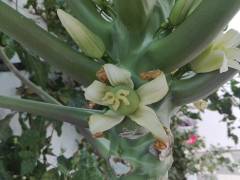
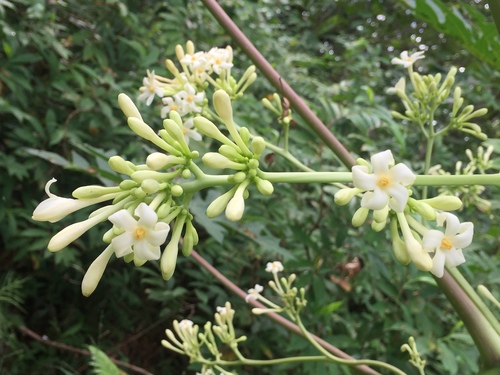
Small (0.4-1 inch / 1-2.5 cm) fragrant cream-yellow 5-petalled flowers appear year-round in tropical climates at the leaf axils on the trunk. Female flowers are large and solitary; male flowers are smaller and in branched panicles; hermaphrodite flowers are intermediate. Fruit ripens 5-9 months after flowering.
Detailed Descriptions
Flower Description
Cream-yellow, 5-petalled, fragrant; cluster size and form differ between male, female, and hermaphrodite plantsFoliage Description
Bright green, deeply lobed palmate, 18-36 inches (45-90 cm) across, in a crown at the apex of the trunkGrowing Conditions
Sun Requirements
Requires 6-10 hours of direct sunlight daily
• Full Sun: 6+ hours of direct sunlight
• Partial Shade: 3-6 hours of direct sunlight
• Full Shade: Less than 3 hours of direct sunlight
Care & Maintenance
Care Guide
Full sun (6+ hours). Soil should be deep, fertile, and well-drained, slightly acidic (pH 6.0-6.5); papaya is intolerant of waterlogged soils and root rots are the principal cause of plant loss. High water needs in dry periods. Foliage is damaged at 32°F (0°C); container plants are moved indoors before first frost in zones 9 and colder. Papaya ringspot virus is the principal disease threat worldwide and can devastate non-resistant plantings; transgenic resistant varieties have been deployed in Hawaii. Common pests include papaya fruit fly (Toxotrypana curvicauda), spider mites, and whiteflies. Latex from cut stems and unripe fruit causes skin irritation in some individuals.Pruning
Pruning is minimal; papaya develops a single trunk and cannot regrow from cuts to the main stem. Leaves yellow and drop naturally as new leaves emerge at the apex. Hermaphrodite or female plants are retained for fruit production; male plants from seed-grown stands are removed when sex is identifiable at first flowering.Container Growing
Suitable for container growing
Minimum container size: 15 gallons