Orobanche, Genus, hederae, Species,
- Genus & species
ivy broomrape
Europe, Mediterranean, and North Africa
Overview
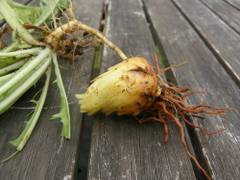
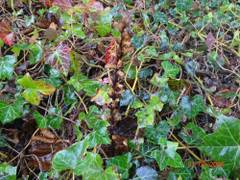
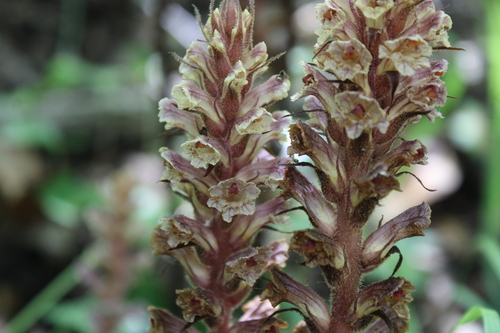
Orobanche hederae is a perennial parasite that lacks chlorophyll and obtains all of its water and nutrients from the roots of ivy (Hedera species). It bears no green foliage; instead the unbranched stem is covered in small brown to purple-tinged scale leaves. Flowering spikes rise 6-24 inches (15-60 cm) tall and hold 10 to many tubular, two-lipped flowers, each 0.4-0.8 inches (10-22 mm) long. Blooms are cream to pale yellow, finely veined and flushed with dull purple, and the style is usually tipped purple. The whole plant is yellowish-brown to purplish and dries to straw-brown as the seed capsules ripen. Underground, swollen attachments called haustoria connect it to the host roots. It grows wherever established ivy carpets the ground or climbs walls and trees, including woodland edges, hedge banks, coastal cliffs, and gardens, mostly on well-drained calcareous soils. Flowering runs from June to August. Each spike produces thousands of dust-like seeds that stay dormant until they detect chemicals from a nearby ivy root. Because it cannot live without its host, O. hederae cannot be grown on its own and appears only where ivy is already well established.
Native Range
Native to western, central, and southern Europe, North Africa, and southwest Asia, with a stronghold around the Mediterranean and along the Atlantic coast of Europe and the British Isles. It is absent as a native from North America.Suggested Uses
Not a conventional garden plant; it appears on its own in ivy-covered banks, woodland gardens, and shaded walls. It holds interest in naturalistic and wildlife settings where ivy is left to grow. It cannot be transplanted or raised in containers.How to Identify
Appearance
Size & Dimensions
Height6" - 2'
Width/Spread4" - 8"
Bloom Information
Flowers from June to August in a dense terminal spike, the lowest blooms opening first. After flowering the spike dries to straw-brown and splits to release thousands of microscopic seeds. Spikes appear only in summers when the host ivy is growing strongly.
Detailed Descriptions
Flower Description
cream flushed with purpleFoliage Description
brown to purple scale leavesGrowing Conditions
Sun Requirements
Requires 2-6 hours of direct sunlight daily
• Full Sun: 6+ hours of direct sunlight
• Partial Shade: 3-6 hours of direct sunlight
• Full Shade: Less than 3 hours of direct sunlight