Oplopanax, Genus, spp., Multiple species,
- Genus
- Multiple species
Devil's club
Northwestern North America and northeastern Asia
Overview
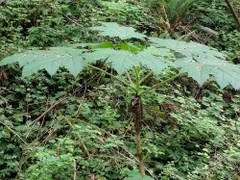
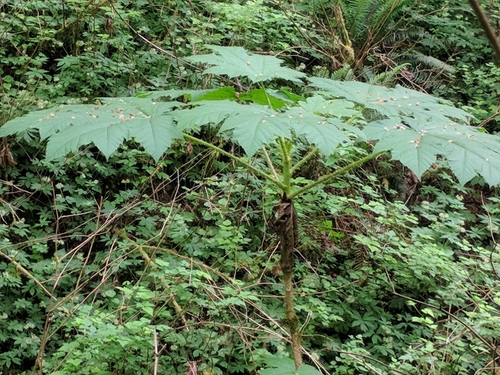
Oplopanax is a genus of deciduous shrubs in the family Araliaceae, with about three species native to moist forests of northwestern North America and northeastern Asia. The genus includes O. horridus, devil's club, of the Pacific Northwest, along with O. japonicus and O. elatus in eastern Asia. Plants form sprawling, thicket-forming shrubs 1-3 m (3-10 ft) tall with thick, upright to leaning stems densely armed with brittle yellowish spines. The large palmate leaves, 20-40 cm (8-16 in) wide, are maple-like with 7-9 toothed lobes and spiny veins and stalks. Erect terminal clusters of small greenish-white flowers open in late spring to summer, followed by flattened, shiny red berries that crowd the spike into autumn. The genus spreads by layering where leaning stems touch the ground, forming dense colonies in damp forest understorey, along streams, and in seepage areas. The spines break off readily in skin and cause irritation. Devil's club holds long-standing cultural and medicinal importance for Indigenous peoples of the Pacific Northwest, who use the inner bark and roots. The plants need cool, moist, shaded conditions and rarely persist in hot or dry sites.
Native Range
Oplopanax is native to the cool, moist forests of northwestern North America, from Alaska south to Oregon and inland to the northern Rockies, and to northeastern Asia including Japan, Korea, and the Russian Far East. It grows in shaded forest understorey, along streams, and in seepage areas.Suggested Uses
Oplopanax is grown in woodland and shade gardens, native plant collections, and naturalistic streamside plantings where its bold foliage and spiny stems suit a damp, shaded setting. The inner bark and roots have a long history of medicinal use among Pacific Northwest peoples.How to Identify
Appearance
Size & Dimensions
Height3' - 10'
Width/Spread3' - 10'
Bloom Information
Flowering occurs from late spring into summer, roughly May to July depending on elevation, in erect terminal clusters of small greenish-white flowers. Pollinated flowers ripen into flattened, shiny red berries that persist on the spike into autumn and are eaten by birds and bears.
Detailed Descriptions
Foliage Description
greenGrowing Conditions
Sun Requirements
• Full Sun: 6+ hours of direct sunlight
• Partial Shade: 3-6 hours of direct sunlight
• Full Shade: Less than 3 hours of direct sunlight